Why In God We Trust motto spread on American cash?
The In God We Trust motto did not arrive on American money by accident. It emerged from wartime anxiety, political calculation, and a long tradition of public symbolism. To grasp why a short phrase ended up on every coin and bill, we need to see how revolutions shape civic identity, from the American Revolution timeline to modern rituals that blend belief and nationhood, like the seasonal practices explored in the study of Sol Invictus and Christmas. Money is not only value; it is a message the state repeats billions of times a day.
Historical Context
During the Civil War, leaders feared moral collapse as the bloodletting deepened. Citizens wrote to the Treasury arguing that Union coinage should acknowledge divine favor. In 1861, Secretary Salmon P. Chase received letters urging a sacred motto. The bureaucracy moved slowly, but the momentum was real. The first official step came in 1864, when the two-cent coin debuted with the inscription. That early adoption created a template: coins could carry civic ideals, not just denominations.
By the Gilded Age, the phrase spread to gold and silver coins. Then came a backlash of aesthetics. In 1907, the elegant Saint-Gaudens designs initially omitted the words, provoking public anger. Congress intervened in 1908 and insisted that the formula remain. The message was clear: symbolism was not merely decorative. It was policy. These fights set the stage for the twentieth century, when the In God We Trust motto would become more than a periodic inscription. It would be the standard line of American money.
Key Facts and Eyewitness Sources
The sequence is straightforward. First, a wartime prompt: citizens, clergy, and officials all pressed for a godly reference. Second, administrative action: Chase directed the Mint to test designs with the new words. Third, legal reinforcement: Congress protected the inscription after the 1907 controversy. Fourth, a Cold War escalation: in the 1950s, lawmakers fused faith and national identity as a democratic contrast to atheistic communism.
Two acts cemented the modern status. In 1955, Congress required that all currency and coinage bear the phrase. In 1956, lawmakers declared it the national motto, formalizing a practice that had become culturally resonant. Paper money followed quickly. The 1957 series of $1 notes marked the first broad appearance on banknotes, and the rollout continued across denominations in subsequent years.
Courts later treated the formula as “ceremonial” and not a theological test. That position mattered. It allowed the phrase to remain while avoiding a government endorsement of doctrine. In short, the historical path combined public pressure, congressional acts, and judicial tolerance. The result was routine repetition: every bill, every coin, and constant daily circulation—exactly the kind of visibility that makes the In God We Trust motto feel immemorial.
For the statute that names the national motto, see 36 U.S.C. § 302. For an accessible overview of the phrase’s broader history, consult this historical profile.
Analysis / Implications
Money is a billboard that no one can avoid. The federal government understood this in the Civil War and again in the Cold War. Each crisis linked national survival to moral purpose. Printing costs were negligible; symbolic returns were large. The In God We Trust motto provided a compact signal that merged patriotism with a shared moral frame without naming a church or creed.
There is also a useful concept from sociology: civil religion. It describes how states employ rituals, sacred dates, and phrases to legitimize authority and foster solidarity. The motto works exactly this way. It is brief, familiar, and nonsectarian enough to pass constitutional muster, yet evocative enough to rally a broad public. That is why it survived court challenges. Judges often call it ceremonial, a habitual statement that functions as heritage rather than theology.
Finally, think about trust—literally the word on the note. Currency circulates only if people accept it. An inscription cannot guarantee stability, but it can signal continuity and shared values. In this sense, the In God We Trust motto is not a talisman. It is a reassurance printed atop the nation’s most common artifact.
Case Studies and Key Examples
From the Two-Cent Coin to the Dollar Bill
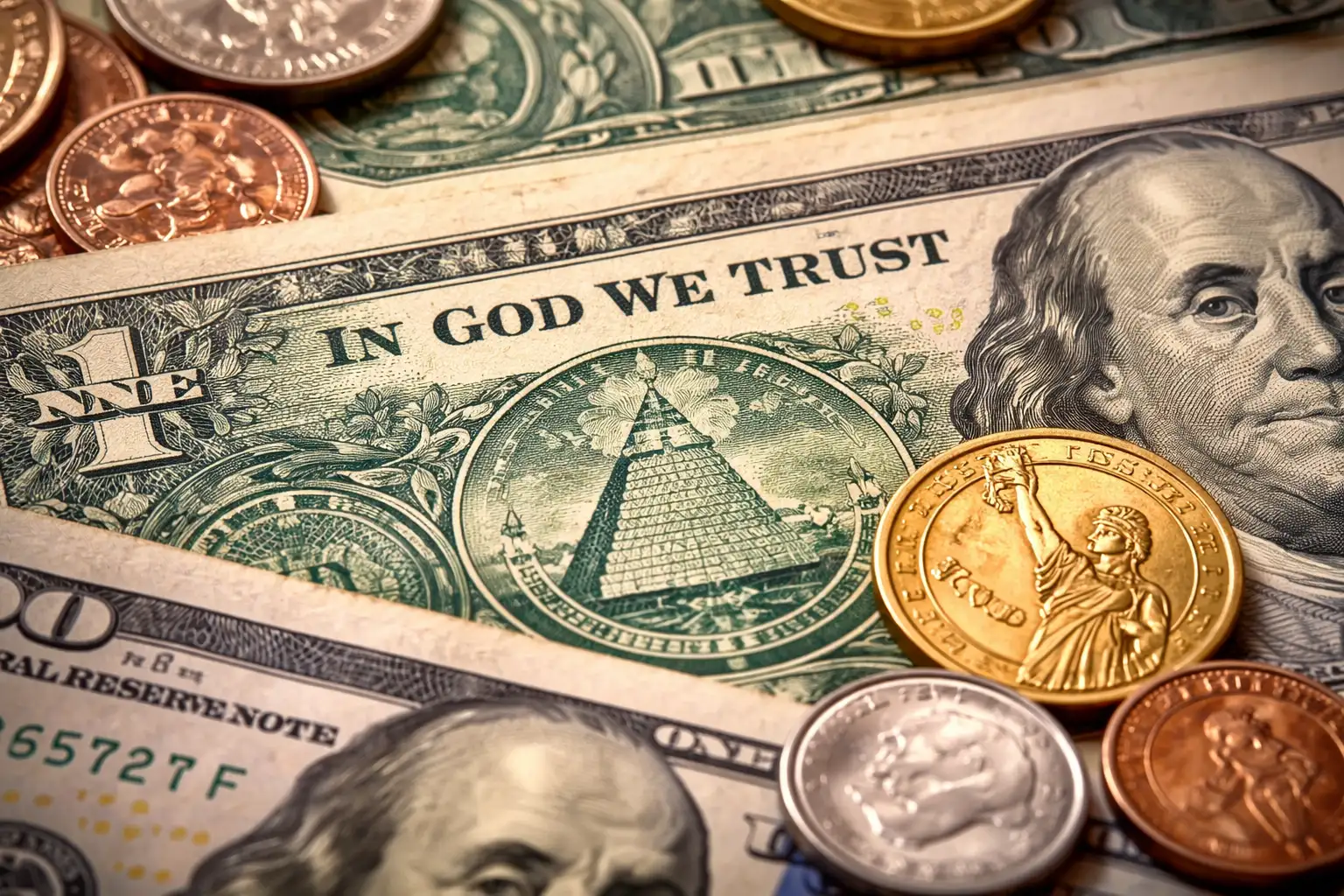
The two-cent coin of 1864 is the starting gun: small in size, large in precedent. Afterward, the phrase appeared on more denominations, including silver and gold issues. The 1907–1908 dispute over the Saint-Gaudens designs became a defining moment. Public protest and congressional action locked the words in place. Half a century later, the Cold War ensured they would cross from metal to paper. The 1957 $1 series showed the words on everyday cash. By the mid-1960s, the spread was broad across denominations, making the In God We Trust motto standard in wallets from coast to coast.
Edge Lettering and Modern Updates
The Presidential $1 coins launched in 2007 initially tucked the inscription on the edge. The novelty was historic but confusing. Many missed the words entirely. In response, Mint officials shifted the motto back to the obverse in 2009. The episode underscored a lesson already learned in 1908: place matters. Visibility keeps a symbol alive. Even design experiments must respect the public’s expectation that the phrase will be obvious. That expectation is the ultimate case study in how repetition turns a statute into habit, and habit into heritage.
Beyond coins, think about the wider storytelling of nations. Hero legends such as Jesse James and frontier myths reflect a taste for moral narratives on which public symbols feed. Encounters between belief and power—like those seen in the conquest of the Americas—reveal why a concise appeal to providence can resonate so widely. The In God We Trust motto sits within that larger, familiar script.
Historical Context, Expanded
Belief, Power, and Precedent
Americans were not the first to entwine piety and policy. Long before the United States, rulers wrapped authority in sacred language. A striking example is the reforming monarch profiled in Akhenaten’s religious revolution. While the contexts differ, the mechanism is similar: public ritual and official text reshape identity. In the American case, the crisis of the 1860s rewarded that approach. It made the minting room a workshop for national meaning.
Over time, that approach became habit. Rituals, slogans, and pageantry are not mere decoration. They are the operating system of civic life. The In God We Trust motto became one of those files always running in the background—subtle, constant, and resilient. It is difficult to repeal a sentence that people have seen since childhood on coins handed to them with change.
Why It Spread: A Four-Part Logic
1) Crisis
In war and geopolitical rivalry, leaders look for unifying messages. The Civil War supplied the first push; the Cold War supplied the decisive one. The motto condensed moral purpose into four words.
2) Visibility
Every transaction multiplies exposure. Bills move faster and farther than speeches. The text on money never leaves circulation. That made the In God We Trust motto a perfect amplifier.
3) Constitutionality
Court language that treats the phrase as “ceremonial” removed existential legal risk. That finding kept politics focused on design and placement rather than repeal.
4) Branding
States brand themselves. Flags, seals, and slogans define the look and feel of public life. In that marketplace of symbols, the United States favored a short, ecumenical phrase that bridged piety and pluralism. It endured because it fit.
Conclusion
The spread of the In God We Trust motto on American cash is the story of how symbols master the everyday. A phrase born in wartime letters found legal armor, Cold War urgency, and a delivery system no citizen can ignore. Coins and bills supplied the repetition that turns policy into culture. Whether one reads the words as heritage or theology, their ubiquity is the point. The state chose a short sentence that could live wherever value moves.
If you want to explore how national myths and institutions shape public life, compare this story with the frontier identities of Sitting Bull’s resistance and the rough-edged justice surrounding Tom Horn on the American frontier. Both remind us that symbols fight for space in culture—and money gives one of them a guaranteed seat at the table.