How Metric system French Revolution rewired daily life
The Metric system French Revolution did more than tidy numbers; it rewired daily life. It turned messy, local measures into a common language for trade, science, and governance. To see the political pressure behind the change, this clear guide on French Revolution causes sets the stage. For the figure who later enforced standardization across Europe, this balanced Napoleon Bonaparte biography is a helpful frame.
Historical Context
From patchwork measures to a single rule
Before 1789, France used thousands of local units. A “pound” in one town was not a pound in the next. Markets ran on bargaining and trust, not comparability. Disputes over grain, cloth, or wine often came down to whose yardstick mattered. Enlightenment writers argued that reason should replace privilege. They wanted a neutral standard that any citizen could use. The revolution opened a path. Reformers proposed natural, decimal units anchored to the Earth, not to royal bodies or guild habits.
Ideas, instruments, and slow transitions
Progress rarely flips overnight. Knowledge accumulates, then institutions catch up. For a reality check on linear “breakthrough” myths, see this analysis of Renaissance turning-point myths. Standards have deep roots. Ancient states already linked authority to shared scales and scripts; this overview of Mesopotamia’s early statecraft shows why. The revolution’s novelty was ambition. It promised universal geometry in everyday life. That promise gave the Metric system French Revolution a moral charge: equality through identical measures.
Key Facts and Eyewitness Sources
Defining the meter and the kilogram
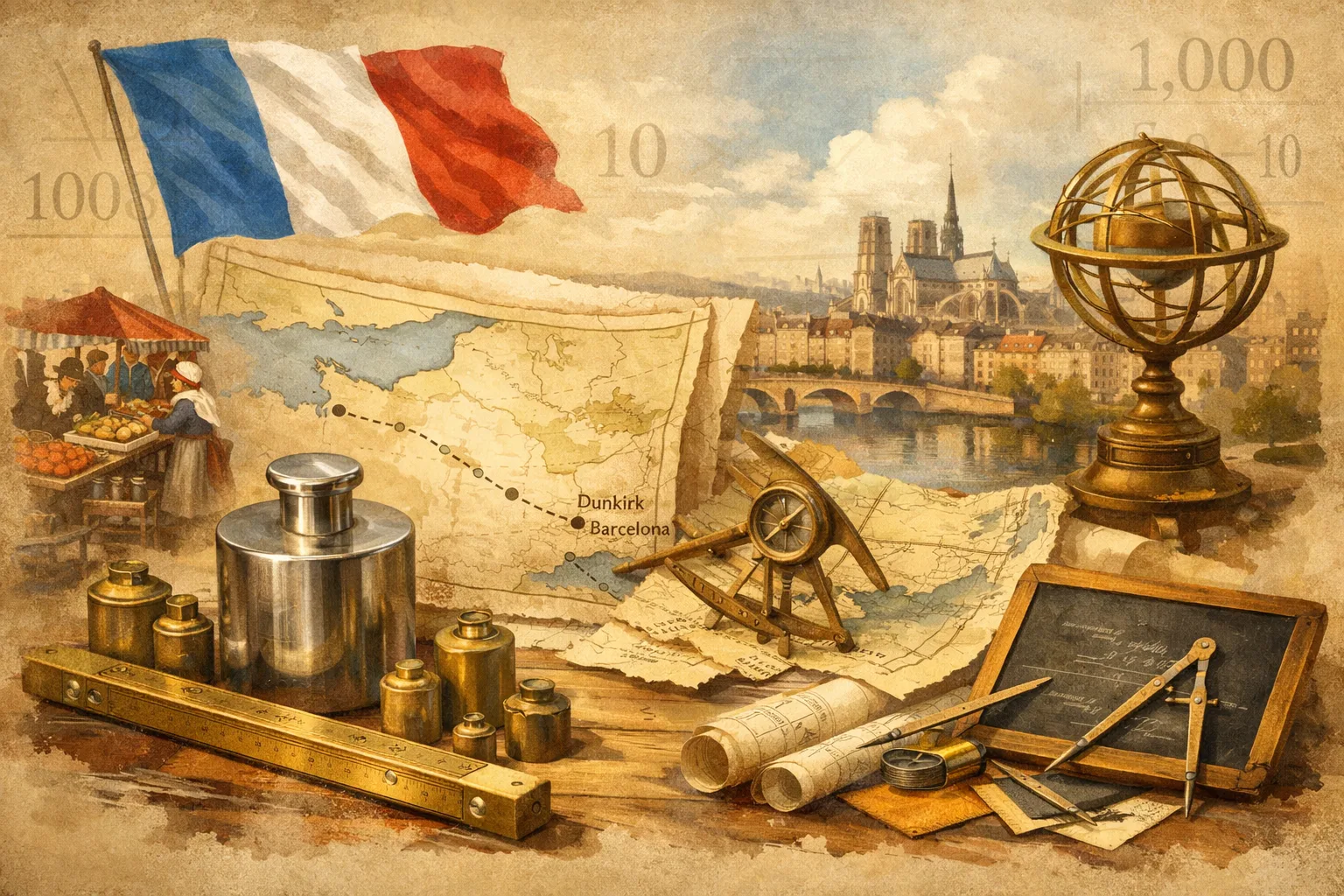
In 1792, surveyors Jean-Baptiste Delambre and Pierre Méchain began measuring the Paris meridian from Dunkirk to Barcelona. Their goal was bold: define the meter as one ten-millionth of the distance from the equator to the North Pole along that line. Weather, war, and illness slowed the work, but the principle endured. On April 7, 1795, France legally adopted metric units. A liter was a cubic decimeter of water; a kilogram was tied to that water’s mass. Brass and platinum prototypes turned theory into objects merchants could trust.
Decimal time and the Republican calendar
Revolutionaries also tried to decimalize time. The day became ten hours, each with 100 minutes. The Republican calendar renamed months and grouped days into ten-day “décades.” Decimal clocks and dual-scale dials appeared in Paris squares and workshops. The public never embraced them. Decimal time was suspended in 1795, and the Gregorian calendar returned in 1806. Yet the attempt mattered. It showed how far reformers would go to align society with number. It also revealed limits: habits of sleep, work, and worship resist abrupt redesign. Even so, the Metric system French Revolution stayed.
Analysis / Implications
What changed in daily life—and why it stuck
Standard units cut transaction costs. A meter in Brest matched a meter in Lyon. Bakers could price loaves by weight, not custom. Apothecaries could dose precisely. Teachers could explain ratios using the same prefixes in every town. The state gained administrative traction: taxes, military supply, and statistics improved. Later, Napoleon compromised with mesures usuelles, mixing old names with metric sizes, then the stricter metric returned in 1840. The long arc shows persistence: once markets and schools reset, inertia favors the new order. That same logic shaped imperial choices like the Louisiana Purchase rationale, where logistics and numbers steered strategy.
From revolutionary France to modern SI
The 1875 Metre Convention created a permanent home for global metrology and led to today’s SI. For current definitions and prefixes, the Bureau International des Poids et Mesures provides the authoritative overview of the SI system. For practical usage rules, spacing, and symbols, the U.S. national metrology institute offers clear guidance in NIST’s SI resources. Together they show the lasting footprint of the Metric system French Revolution: a universal language of measurement, refined by physics but rooted in a political experiment.
Case Studies and Key Examples
Markets, recipes, and the kitchen scale
Consider a city market in 1795. Prices quote per kilogram. Butter sellers stop using heaped measures. Fraud becomes harder because weights match engraved standards. Cookbooks adopt liters and grams. Households learn by doing. The reform breaks barriers between regions. The same pastry can be baked in Marseille or Lille without adjusting for a local “pint.” The Metric system French Revolution thus changed the home, not just the laboratory.
Hectares, cadastres, and fairer taxes
Land records once bristled with local units. That fed disputes and uneven taxation. A hectare—10,000 square meters—simplified surveys. Inspectors could walk plots with standardized chains. Maps became consistent; boundaries were audited. Farmers paid on area measured the same way across departments. The change gave rural France clearer property rights and smoother markets for leases and loans.
Public health: making the invisible measurable
After 1952, cities learned to monitor air quality with comparable metrics. London’s crisis, revisited in this synthesis of the Great London Smog, shows how units, instruments, and rules save lives. Particles per cubic meter, sulfur dioxide limits, and standard sampling transformed debate. The lineage back to the Metric system French Revolution is conceptual: define shared quantities, publish thresholds, and act on numbers rather than anecdotes.
Conclusion
The revolution promised equal citizenship; equal measures were part of that promise. A meter in Paris had to be a meter in the provinces. That idea proved durable. It made trade fairer, science clearer, and governance steadier. Attempts to decimalize time failed, but the core reform endured and spread worldwide. The result is a daily fluency: we buy fuel by the liter, read drug dosages in milligrams, and plan space missions in meters per second.
To compare how different upheavals standardize rules, this map-like American Revolution timeline offers parallels. For a modern echo of measurement’s quiet power, see how chipmaking lives by tight metrics in this analysis of Taiwan’s semiconductor ascent. In both stories, numbers are not decoration. They are the rails on which complex societies move.