Mesopotamia history: The Cradle of Civilization Explained
Mesopotamia history begins between the Tigris and Euphrates, where people shaped cities, writing, and law. This guide traces how rivers, clay, and cooperation built the world’s earliest states. For comparisons with other prehistoric feats, see the practical analysis of Stonehenge builders’ theories and the long arc of innovation in how the Maya civilization changed history. Short sections, clear examples, and reliable milestones make the story accessible without losing depth.
Historical Context
From Floodplain to First Cities
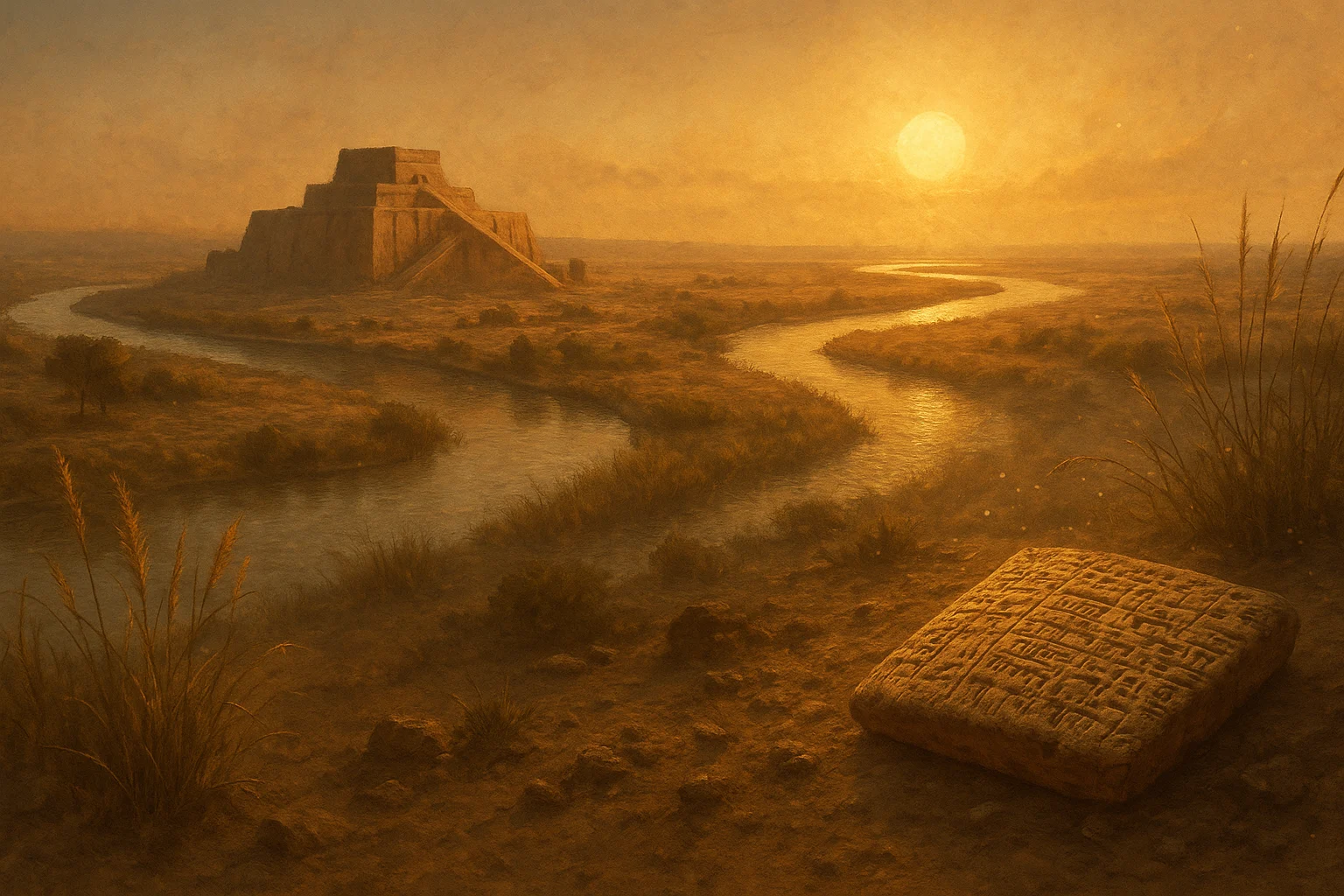
In southern Iraq’s alluvial plain, seasonal floods dropped fertile silt. Communities dug canals, built levees, and coordinated labor. By the fourth millennium BCE, Uruk expanded into a true city with temples, craft districts, and storage complexes. Tokens and bullae evolved into cuneiform, pressed into clay to track grain, debt, and rations. That administrative breakthrough anchors Mesopotamia history because it scaled trust. It turned memory into records and meetings into procedures. Architecture followed: platforms rose into stepped temples—ziggurats—framing ritual, surplus, and authority in one skyline.
Kingdoms, Empires, and Continuity
Sargon of Akkad forged an early empire around 2334–2154 BCE. Later, Hammurabi unified much of Babylonia in the eighteenth century BCE with law, roads, and diplomacy. Assyrian power peaked in the first millennium BCE with fast armies and planned resettlements. Neo-Babylonian kings revived monumental building before Cyrus the Great folded the region into the Achaemenid Empire in 539 BCE. For curated artifacts and timelines, consult the British Museum’s Mesopotamia collections and the Met’s Heilbrunn Timeline for Mesopotamia, 8000–2000 B.C.. Roman frontiers later brushed the region; see how strategy shifted in this concise Hadrian biography.
Key Facts and Eyewitness Sources
Clay Tablets as Voices
Clay speaks. Tablets record contracts, teacher–student drills, letters, hymns, and the Epic of Gilgamesh. Scribal schools copied lists of gods, cities, metals, and verbs. Numbers used a sexagesimal system; sixty still frames our minutes and degrees. Astronomers logged eclipses and planetary motions with care that later guided Greek and Hellenistic models. By reading these tablets, historians rebuild daily life—rations, wages, deliveries—and test narratives against receipts. That documentary density makes Mesopotamia history unusually transparent for such deep time.
Monuments, Measures, and Methods
Ziggurats announced power and piety. Cylinder seals authenticated goods, turning art into administration. Standardized weights, measures, and silver equivalences lubricated trade from the Gulf to Anatolia and Iran. Canals required seasonal planning and communal enforcement; kings boasted of dredging works and flood control. Libraries mattered too. Ashurbanipal’s collection at Nineveh preserved myths, medicine, omens, and mathematics. Together, these facts show a society where technique and belief reinforced each other, and where paperwork—on clay—could move armies and bread.
Analysis / Implications
Institutions, Not Magic
Mesopotamian states endured because institutions handled risk. Irrigation schedules, harvest forecasts, and temple stores absorbed shocks. Bureaucrats tracked grain, land, and people; courts settled disputes with predictable procedures. That logic echoes in other long-lived polities; compare the pragmatic statecraft behind Byzantine endurance. In both cases, resilience came from adaptable rules and repeatable routines, not from a single heroic moment. Mesopotamia history therefore reads like an operations manual that early rulers kept updating.
Innovation That Scales
Writing amplified memory; numbers amplified planning; contracts amplified trust. Temples and palaces coordinated labor while merchants linked distant markets. Knowledge traveled with goods—metals, timber, stone—and returned as stories, techniques, and texts. Modern readers love “great resets,” yet progress often layers rather than leaps. For a careful critique of rupture myths, see this guide to debunking Renaissance turning-point myths. In that spirit, the ancient Near East stands not as a lost world but as scaffolding under later science, law, and administration.

Case Studies and Key Examples
Uruk and the Urban Toolkit
Uruk’s growth shows how simple tools can transform scale. Bevel-rim bowls standardized rations. Sealed jars enforced accountability. Clay tablets tracked deliveries across neighborhoods and seasons. The city’s temples concentrated surplus and redistributed it through workshops. Crafts specialized—textiles, metalwork, and ceramics—while neighborhoods clustered by trade. This tight mesh of storage, recordkeeping, and ritual created an urban metabolism. It explains why Mesopotamia history begins not with a throne but with a ledger.
Hammurabi’s Law as Technology
Hammurabi (r. c. 1792–1750 BCE) carved 282 laws that codified contracts, liability, and penalties. The text distinguishes social ranks and specifies terms for wages, loans, and damages. Its force was part message, part method. Public rules reduced bargaining costs and curbed local arbitrariness. Courts could point to written standards rather than custom alone. The result was a predictable environment for farmers, traders, and builders. Law here behaves like infrastructure: a road of words that moves obligations swiftly and fairly.
Assyria’s Logistics Machine
Assyrian kings built roads, relays, and depots to move troops and information fast. Reliefs show siege ramps, impaled timbers, and chariots—but also carts, pack animals, and ledgers. Conquests brought tribute and trained administrators to new provinces. The system was harsh, yet technically sophisticated. It foreshadows the Eurasian webs that later boosted steppe empires; for a wide-angle comparison of empire as a logistics network, see the untold story of Genghis Khan’s legacy. Both cases show how speed and storage decide power.
Babylonian Skies and the Mathematics of Time
Babylonian scholars compiled astronomical diaries tracking lunar and planetary cycles. They predicted eclipses and mapped regularities with sexagesimal math. Dividing the circle into 360 degrees and the hour into 60 minutes was not an aesthetic choice; it was a computational one. Water clocks and observation routines turned the heavens into a data source and a calendar. When later astronomers borrowed these tools, they borrowed a worldview: that careful notation can turn the future into a forecast. Mesopotamia history thus lives on your clock and map.
Conclusion
Mesopotamia was not a single kingdom but a centuries-long workshop where people learned to govern complexity. Rivers demanded schedules; fields demanded ledgers; cities demanded courts. Out of that pressure came writing, law, and measured time. We still inherit their habits when we sign contracts, balance accounts, or set our watches. If you want to see how later thinkers organized knowledge into schools and systems, explore this concise Plato biography and a clear overview of Aristotle’s method. Read them as continuations of a much older conversation about evidence, order, and the good life.