How Hoover Dam power politics shaped the modern Southwest
Hoover Dam power politics set the rules of growth in the American Southwest. It determined who controlled water, who profited from electricity, and which cities would boom. The story blends federal ambition, local rivalry, and engineering daring. It also intersects with Indigenous claims, from Apache resistance remembered in this Geronimo biography, to modern water rights. And it exposes how public finance is often sold through simple narratives, a pattern explored in American Lottery Secrets.
Historical Context
Compacts, Carve-Ups, and the Boulder Canyon Act
Before concrete met canyon, the region negotiated law. The 1922 Colorado River Compact split the basin into Upper and Lower halves, promising each a large share of annual flow. The 1928 Boulder Canyon Project Act then authorized Hoover Dam and the All-American Canal, and apportioned water among California, Arizona, and Nevada. Hoover Dam power politics emerged inside these documents. Water would tame floods and irrigate fields, but electricity would pay back the project and fund the federal state’s expanding role. The contracts for power would decide which cities gained industry and which stayed small.
California moved fast. Los Angeles, through municipal leadership and alliances with private utilities, lined up long-term power. Arizona pushed back, wary of California’s reach. Nevada, tiny but strategic, angled for growth. The federal government sat in the middle, using prices, contracts, and preferences to steer outcomes. The result was an energy map that prefigured the region’s urban future.
New Deal Momentum and the Renaming Politics
Construction began as the Great Depression deepened. Thousands of workers arrived, and Boulder City arose as a federal company town. New Deal urgency accelerated schedules and made Hoover a symbol of modern state capacity. Yet symbolism hid conflict. The early “Hoover” naming linked the dam to President Herbert Hoover; later rhetoric favored “Boulder Dam” under President Franklin D. Roosevelt. Congress ultimately restored “Hoover Dam” after the war. Those shifts were not mere labels. They revealed how Hoover Dam power politics lived in language, budgets, and public memory—who took credit, and whose power contracts locked in advantage for decades.
Key Facts and Eyewitness Sources
Work, Risk, and the Six Companies Consortium
Between 1931 and 1936, more than ten thousand men worked in brutal heat, blasting, tunneling, and placing massive concrete blocks. Eyewitness accounts describe night pours to escape daytime extremes and the roar of diversion tunnels. The Six Companies consortium coordinated construction with a speed that impressed observers and unsettled critics. Official records list more than ninety worker deaths, though the broader toll of heat, accidents, and illness was higher in community memory. These labor realities matter because they underwrote the promised benefits. Hoover Dam power politics rested on workers’ bodies as much as on legal texts and balance sheets.
Electricity sales covered costs and defined winners. Long-term contracts channeled power to municipal buyers and private firms. Cheap hydropower attracted smelters, refineries, and defense plants during World War II. In turn, industries reinforced urban migration. The pattern shows a feedback loop: contracts begat factories; factories begat population; population secured more political leverage.
Records and Public Sources
To trace the project’s official story—timelines, operations, and allocations—consult the U.S. Bureau of Reclamation’s Hoover Dam. For a concise overview of structure, capacity, and legacy, see the Encyclopaedia Britannica entry on Hoover Dam. These sources reflect formal narratives, while personal letters, newspaper dispatches, and workers’ recollections reveal daily experience. Read them together to see how policy claims met practical realities. The contrast is stark, and it is where Hoover Dam power politics becomes visible: in the gap between grand national plans and lived local consequences.
Analysis / Implications
Water, Wires, and Metropolitan Asymmetry
Hoover set a template: use federal capital to build a megaproject, repay through power sales, and steer regional growth via contracts. That model advantaged early movers. Los Angeles grew first because it secured predictable supply. Las Vegas, then a tiny railroad stop, leveraged proximity, federal employment, and later gaming to ride cheap electricity. Phoenix benefited indirectly as subsequent projects extended the network. The point is simple: Hoover Dam power politics selected winners not only through law, but through the cadence of infrastructure finance.
The dam also shaped risk. Over-allocations baked optimism into policy. When flows fell short, friction grew among states, cities, and tribes. Energy demand compounded choices: more load meant tighter reservoirs. Management became a civic art of balancing hope with hydrology.
From Chokepoints to Narratives of Power
Rivers can be chokepoints, much like maritime straits. Control over release schedules and prices translated into regional leverage, analogous to why the Strait of Hormuz leverage matters for global oil flows. Public opinion also mattered. During war, morale and messaging combined with industry; the idea of engineered invincibility paralleled the illusions explored in The Ghost Army of WWII. Crises rewrite institutions, a pattern seen after pandemics such as the Black Death. Megaproject narratives promise mastery over nature, yet history—from Krakatoa’s eruption to modern droughts—reminds us that nature renegotiates every contract.
Case Studies and Key Examples
Los Angeles: Contract Power and Industrial Scale
In Southern California, early, aggressive contracting locked in a large share of Hoover’s output. Utilities and the municipal department coordinated transmission, enabling aircraft manufacturing and refining to expand during World War II. The city’s population surge followed the grid. Hoover Dam power politics, therefore, materialized in factory sites and neighborhoods, not just in meeting minutes.
Las Vegas and the Magnesium Experiment
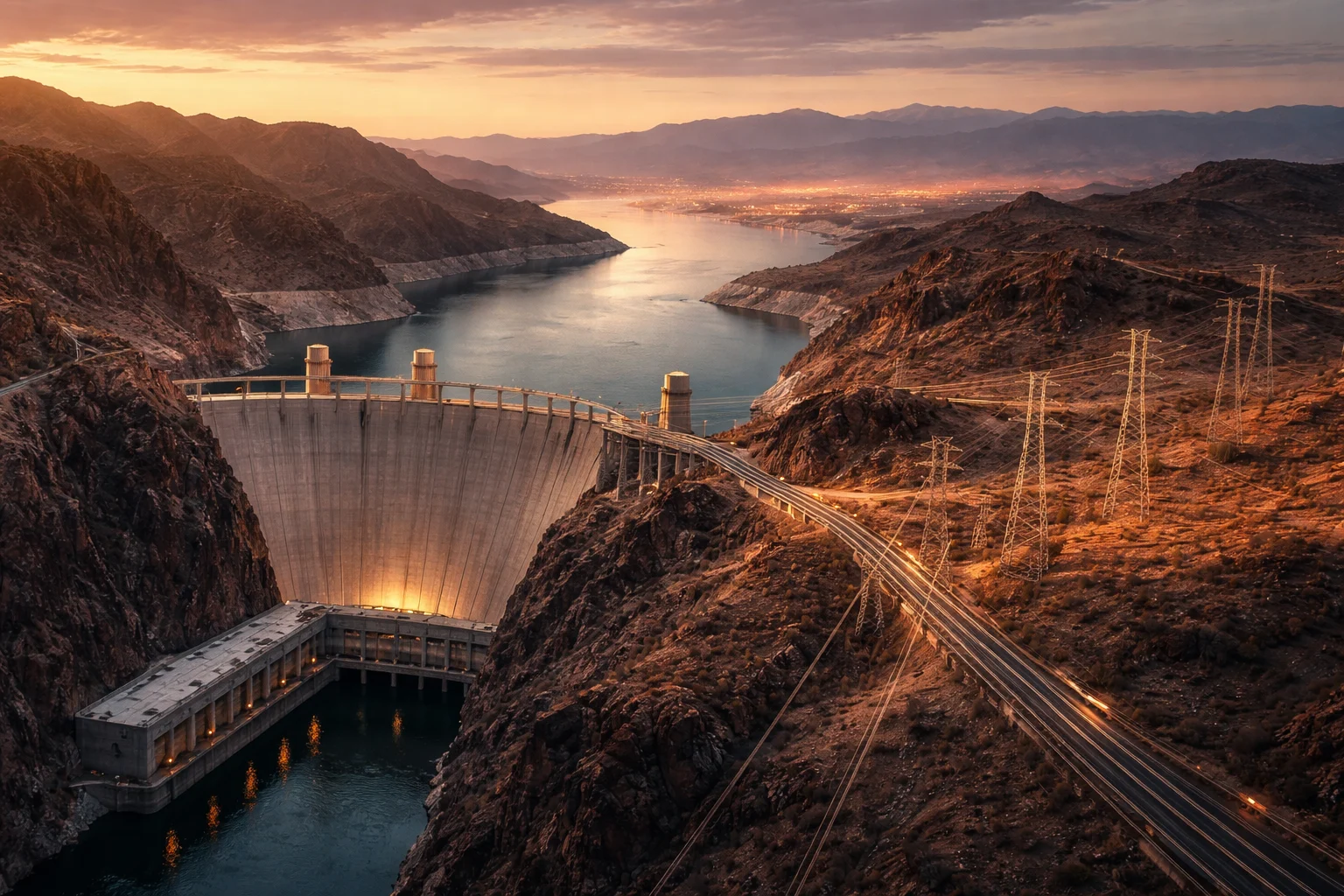
Near Henderson, wartime producers used Hoover power to make magnesium—“the metal of victory.” The plant seeded an industrial base and trained a workforce. Federal payrolls and cheap electricity then fed tourism and gaming. Each phase compounded the next. By mid-century, Las Vegas had a unique mix of federal legacy and private enterprise, built on the wires strung from Black Canyon.
Arizona’s Long Game and Tribal Rights
Arizona’s political struggle over allocations lasted decades, culminating in legal confirmations and later projects that brought water deeper into the state. Tribal water rights, recognized in principle early in the century, gained force through settlements and court decisions. These developments reframed Hoover’s legacy: not only an icon of concrete, but a catalyst for new claims. In that sense, Hoover Dam power politics continues across negotiation tables today, where sovereignty, equity, and climate realities meet.
Conclusion
Hoover was never just a dam. It was a machine that converted river flow into political capital. It picked urban winners, financed federal capacity, and promised resilience, even as it embedded new fragilities. Seen this way, Hoover Dam power politics offers a durable lesson: infrastructure is strategy. Contracts outlast speeches. Transmission lines shape maps. And every promise about nature carries an asterisk.
Those lessons travel well. Nations now debate semiconductor fabs, rare-earth supply chains, and resilient grids—issues not unlike water and wires in the 1930s. For a contemporary parallel, see why Taiwan’s semiconductor rise matters. And for a reminder that governance hinges on everyday rules, from permits to policing, consider how ancient Rome dealt with crime. The throughline is clear: build wisely, price fairly, and write contracts that future droughts—and future generations—can live with.