Sea Of Milk Phenomenon: Why Sailors Saw Glowing White Seas
The Sea Of Milk Phenomenon turned night oceans into ghostly white sheets that seemed to glow from within. For centuries, crews logged the sight with awe and fear. Some blamed storms or volcanoes, like those tied to Krakatoa’s 1883 eruption. Others folded it into tales beside puzzles such as the Mary Celeste. Today, science points to living light—vast carpets of luminous bacteria—yet the scale still surprises. This guide gathers history, eyewitness detail, lab clues, and satellite breakthroughs to explain why entire seas can shine white, steady, and eerily calm.
Historical Context
Mariners have described whitened oceans for centuries. In logbooks, phrases like “sea of milk” or “white water to the horizon” appear on moonless nights. The glow was not the usual sparkles stirred by wakes. It was uniform and quiet, as if daylight seeped up from the deep.
Most sightings cluster in warm waters of the northwestern Indian Ocean and the Maritime Continent. These trade lanes carried spices, textiles, and news. Reports spread with the ships. The Sea Of Milk Phenomenon became shared lore across navies and merchant fleets. Sailors used metaphors of snowfields, mist, and cloud.
Before modern sensors, explanations ranged from phosphorescent “mold” to supernatural omens. Naturalists later proposed living light. That idea gained traction as researchers cataloged small flashes from disturbed plankton and larger, steady glows in calm seas. But how could the light stay uniform over hundreds of kilometers?
Key Facts and Eyewitness Sources
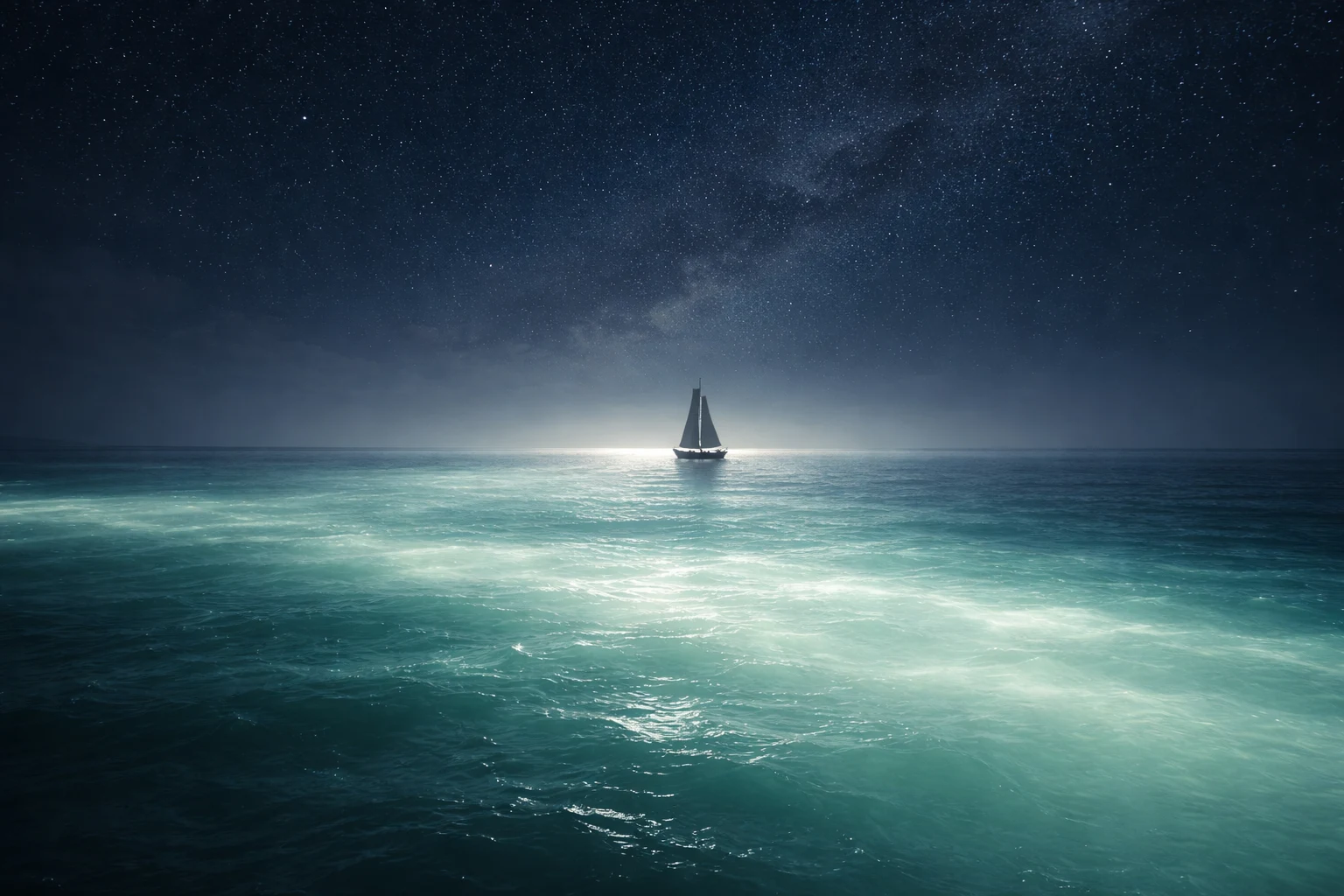
Milky seas produce a soft, steady, whitish glow. It does not flicker with wave slap. Ships cutting through the field do not switch the light on and off. Instead, the surface appears suffused, like a backlit screen. Officers wrote of sailing in “liquid moonlight.”
Modern evidence sharpened in two leaps. First, satellite night-vision sensors revealed broad luminous patches persisting for many nights. Second, a yacht crew documented the 2019 Java event with photographs and logs, while satellites watched the same glow. That unique pairing—shipboard images and orbital detection—turned a fable into a mapped phenomenon, as detailed in a PNAS study of the 2019 Java milky sea.
Eyewitness narratives align: a uniform white blanket to every horizon, often under clear skies and with calm water. The light sometimes appears slightly greenish, like diluted lime. The Sea Of Milk Phenomenon may last hours to weeks, drifting with surface flows.
Analysis / Implications
The leading mechanism is bacterial bioluminescence triggered by quorum sensing. When luminous bacteria reach a critical density, chemical signals flip on their light-emitting genes. In a milky sea, that switch happens on a grand scale. The likely partners are blooms of microalgae that host or feed the bacteria.
Satellite data and ship logs suggest milky seas favor stable surface layers, warm water, and expansive blooms. That combination lets bacteria multiply and synchronize their glow. The difference from point-like sparkles is the shared “on” state, not turbulence-triggered flashes.
The 2019 Java event likely exceeded 100,000 square kilometers and persisted for over a month. Such scale has climate and ecosystem implications: widespread bacterial activity, altered grazing, and unusual optics at the sea–air boundary. A technical overview of methods and detections appears in NOAA’s synthesis of the Java case, available in this NOAA analysis of the 2019 Java event.
Case Studies and Key Examples
Java, 2019. Satellites first flagged a vast, persistent glow south of Java. A sailing vessel later entered the field and recorded photos and notes that matched the orbital footprint. The glow endured for 40+ nights and spanned an area larger than many countries. The Sea Of Milk Phenomenon here offered a clean, modern “experiment”: ship images, logs, and VIIRS night-band data lined up in space and time.
Somali Basin, 1995. A merchant ship described brilliant white water from horizon to horizon. The crew likened it to snow underfoot. Retrospective analysis matched satellite data from older sensors, indicating a luminous patch roughly the size of a small U.S. state. This case cemented the idea that milky seas can be tracked after the fact.
Arabian Sea, 1985. A research vessel sampled a milky sea and found luminous bacteria in abundance. The glow was steady, not turbulence-based. Later hypotheses proposed that bacteria colonize slicks associated with certain algae, creating a large, thin “light sheet.” The Sea Of Milk Phenomenon thus becomes a microbial landscape-scale event.
What Makes Milky Seas “Milky” and Not Blue?
Most bioluminescent displays appear blue because seawater transmits blue light well. Milky seas look whitish because the light is weak but everywhere. Our eyes integrate the glow across the whole field and interpret it as pale gray or white, especially under dark adaptation. Photographs can skew colors; crews often report a greenish cast.
Uniformity is the key. Instead of billions of tiny flashes, the emitting layer behaves like a continuous surface. The Sea Of Milk Phenomenon is, in effect, a living lampshade stretched across the water—thin, delicate, and continent-scale.
Separating Milky Seas from Maritime Myths
Sailors collect legends. Ghost ships, vanishing crews, and glowing waters share the same pages. It helps to compare records. The Ourang Medan mystery and the documented Mary Celeste saga show how stories evolve when facts are scarce. Milky seas, however, leave physical signatures: geometry, duration, and spectral behavior.
Disasters at sea also supply context. Navigation, shipping density, and rescue timelines shape what gets seen and reported, as explored in the reappraisal of the Andrea Doria collision. Long, calm nights in busy lanes produce more witnesses. That is one reason the Sea Of Milk Phenomenon appears repeatedly in trade corridors.
Even distant atmospheric events can mislead observers. Luminous nights after large explosions, such as those studied for the Tunguska event, remind us that unusual light has many causes. Cross-checking logs with satellite archives and ocean color maps filters milky seas from other glows.
How Scientists Detect Milky Seas Today
Low-light satellite sensors, especially the VIIRS Day/Night Band, catch faint emissions over dark oceans. Analysts look for steady patches that persist across multiple nights and move with currents. Those signals differ from city lights, flares, and ships. The workflow now ties orbital detection to field opportunities.
When vessels are nearby, researchers ask crews to note color, brightness, and wake effects. The best cases combine photography, logs, and coordinates. Historical research adds thousands of older reports to train statistical models. Even exploration narratives, like the second voyage of Columbus, help calibrate expectations about routes, seasons, and sky conditions.
As archives grow, the Sea Of Milk Phenomenon looks less like a curiosity and more like a recurring microbial state of the ocean. That shift opens questions about ecology, chemistry, and climate sensitivity.
Practical Implications for Mariners and Science
For crews, milky seas are striking but not dangerous. They may indicate stratified, nutrient-rich surface layers and active microbial communities. For scientists, these events are natural laboratories on quorum sensing at planetary scale. Understanding them could refine models of carbon cycling and surface optics.
The Sea Of Milk Phenomenon also stresses interdisciplinary work. Oceanographers, microbiologists, atmospheric scientists, and remote-sensing experts must sync timelines and tools. When a patch is detected, ships can sample bacteria, algae, and water chemistry. Even negative results help by narrowing conditions.
Policy interest is rising too. Monitoring luminous events in chokepoints and busy lanes supports better situational awareness. The Indian Ocean, Sunda Strait approaches, and nearby arteries draw attention for both ecology and trade.
Conclusion
Milky seas changed from mystery to mechanism: bacteria, quorum sensing, and a vast, uniform glow. The picture formed by sailors’ logs, lab work, and satellites is now coherent. The Sea Of Milk Phenomenon is a living film stretched across calm, warm waters, powered by microbial communication.
Context keeps the story honest. Maritime corridors and straits shape who sees what and when. For how sea lanes concentrate risk and observation, compare the strategic lens on the Strait of Hormuz and the history of brinkmanship across the Taiwan Strait. Different topics, same lesson: geography focuses attention. In the end, a ghostly white ocean is not a portent. It is a signal from the smallest ocean citizens, glowing together at planet scale.