Vienna 1683 Ottoman Siege: Why The Advance Stalled
The Vienna 1683 Ottoman Siege is a turning point in early modern warfare. It reveals how logistics, leadership, and time can outweigh numbers. This article unpacks why the advance slowed, why relief could arrive, and how the siege reshaped Europe. For wider siege parallels, see the desert stand at Masada’s last stand and the late antique shock of the 410 sack of Rome. We move step by step, from context to eyewitness detail, then to analysis and case studies that make the campaign’s logic clear.
Historical Context
A second attempt after 1529
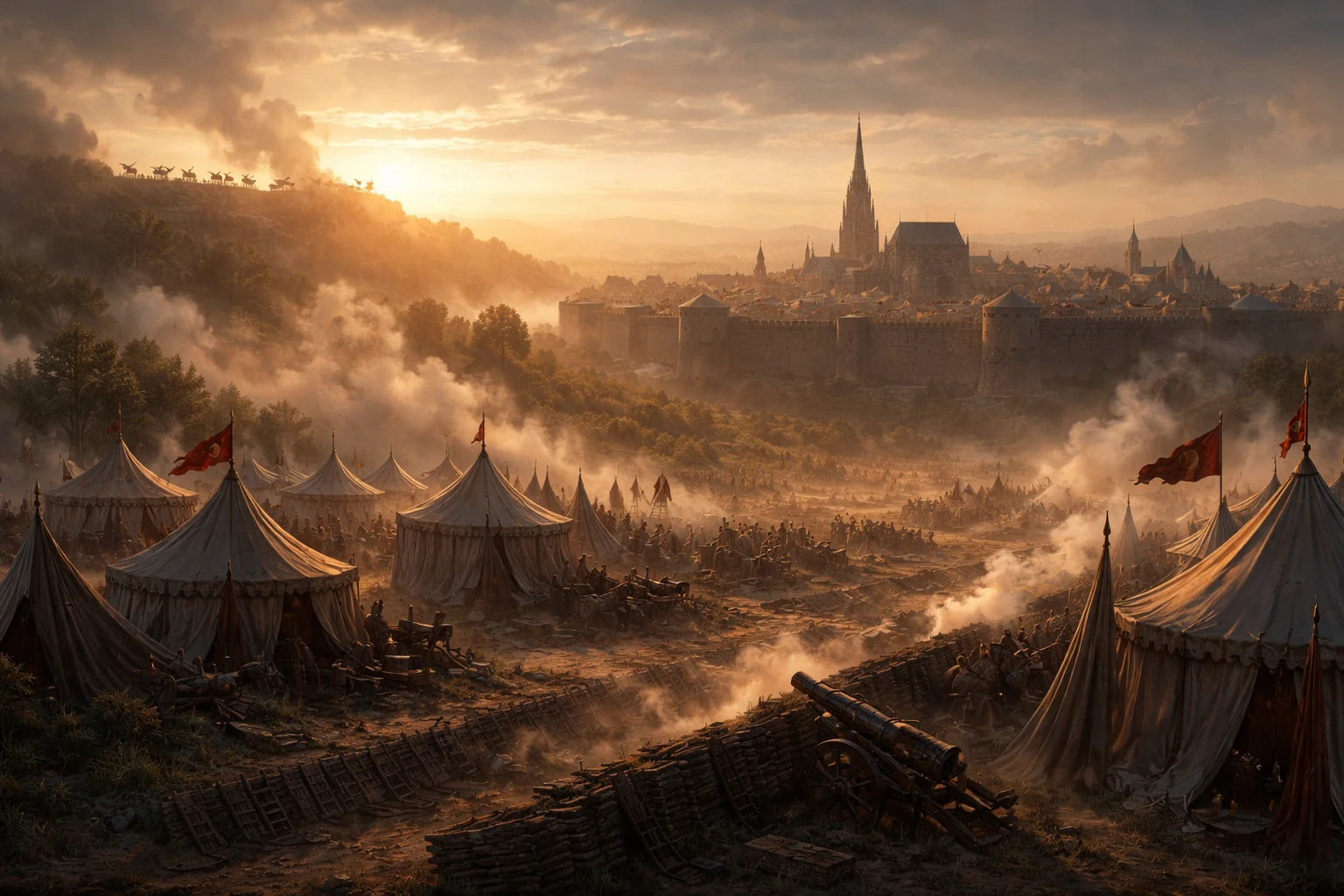
The Vienna 1683 Ottoman Siege followed a century and a half of shifting borders, truces, and raids along the Habsburg–Ottoman frontier. Vienna’s defenses had been modernized since 1529. Bastions, ravelins, and glacis redirected cannon fire and complicated assault ladders. Inside the city, a compact garrison guarded walls while engineers repaired damage each night. Outside, the Grand Vizier Kara Mustafa Pasha led a large, multiethnic army built for siege and intimidation. A concise overview is available in Britannica’s entry on the siege, which charts the dates and main commanders without romanticism.
Fortress and frontier: Vienna’s position
Vienna was not just a capital. It sat on river routes, trade corridors, and the hinge between imperial lands and the Hungarian plain. Fortifications protected narrow approaches and forced attackers to dig, mine, and creep forward. That tempo favored defenders. It also bought time for allies to assemble. In 1683, the imperial court evacuated, yet command in the field held together. Scouts kept watch from hilltops. Couriers rode between camps, convents, and strongpoints, turning rumor into working intelligence.
Alliances and rivals
Politics shaped the battlefield. The Habsburgs needed German princes, Bavarians, and Saxons. Most crucially, they needed Poland–Lithuania’s king, John III Sobieski. He secured the Vistula and mustered cavalry famed for shock tactics. On the Ottoman side, internal rivalries mattered. Some provincial contingents guarded supply lines loosely. Tartar auxiliaries prioritized raiding over trench duty. Meanwhile, Hungarian rebels under Imre Thököly complicated the imperial rear. All sides watched the calendar. Each week of digging changed coalition math.
Key Facts and Eyewitness Sources
Timeline: July to September
The Vienna 1683 Ottoman Siege opened in mid-July with investment and trenchwork. Sappers advanced zigzag lines toward bastions. Miners packed charges under counterscarp galleries. Defenders countermined, flooding tunnels or detonating back. August brought larger craters and battered walls, but no breakthrough. Early September saw intensified mining near the Burg and Löbel bastions. On September 12, a relief army crested the heights above the city. What followed was a decisive day of maneuver that the besieging camp could not absorb.
Inside the trenches: mining and countermining
Ottoman engineers excelled at sapping. They pushed galleries under angles, set charges, and rushed storm parties at the moment of breach. The defenders fought the ground itself. They rebuilt parapets with earth-filled fascines. They dug traverses to limit enfilade fire. Every crater became a contested amphitheater. Reports from the walls describe smoke, dust, and the deafening thump of mines. Night labor mattered. Each dawn revealed fresh obstacles for attackers, and fresh scars for defenders to mend.
Voices from both camps
Letters from city commanders measure days in rations, powder, and horses. Imperial notes track the morale of guilds turned into work crews. Meanwhile, observers in the Ottoman lines recorded discipline and splendor beside fatigue. Some chroniclers name the Grand Vizier as rigid in plan yet confident in numbers. Others stress the endurance of sappers and janissaries under heavy fire. The pattern that emerges is not of weakness but of mismatch: formidable siege craft, stretched over too wide a perimeter, against defenders who could trade ground for time.
Analysis / Implications
Logistics beat numbers
Why did the Vienna 1683 Ottoman Siege stall? Supplies, distance, and river control set the limits. The Danube and its tributaries could nourish an army, but only with secure crossings and guarded convoys. Wagon miles multiplied as trenches lengthened. Fodder ran short near the city. Forage parties met ambushes. Bread ovens in forward camps struggled to keep pace. Without firm control of the river islands and bridges, siege tempo slowed. Each delay helped the defenders and the allies assembling beyond the horizon.
Command choices and coalition timing
Two choices proved critical. First, the besiegers focused on mining and walls rather than building a full circumvallation to block relief forces. Second, the camp remained dispersed across a broad arc. That posture made sense for a long investment, but it risked surprise from the heights. Coalition timing punished those choices. Sobieski moved fast and struck first. Imperial and German columns synchronized with Polish wings. When battle opened above the city, reserves in the Ottoman lines were too far to mass quickly.
The plateau of expansion
Defeat at Vienna did not end Ottoman power. It did reveal strategic limits in central Europe. Firepower, entrenchments, and coalition warfare were changing the cost of conquest. The siege marked a hinge. Armies that ignored logistics and political tempo discovered ceilings. States that mastered both extended influence. The Habsburgs learned to coordinate princes and paymasters. The Ottomans could still fight effectively, but momentum now favored defenders with strong fortresses and partners ready to share risk.
Case Studies and Key Examples
The Kahlenberg attack and the hussar charge
On September 12, relief forces climbed the wooded ridges northwest of the city. Scouts mapped ravines, vineyards, and clearings. Artillery probed the flank. In the afternoon, Polish cavalry—most famously winged hussars—launched downhill in coordinated waves. Shock met a stretched line. The attack hit camp edges, not just the front, collapsing cohesion. For visual context, examine the Wilanów Museum’s materials on the Battle of Vienna, which preserves iconography and commentary on Sobieski’s role. The tactical sequence shows how an army designed to besiege a city can be vulnerable to a sudden field battle on uneven ground.
Why relief arrived at all: the missing wall behind the wall
A classic investment uses circumvallation against the city and contravallation against outside forces. At Vienna, a complete outer belt never solidified. Patrols and redoubts existed, but not a continuous barrier. That gap allowed allied columns to approach, deploy, and coordinate. The Vienna 1683 Ottoman Siege therefore became a race between mines and marching timetables. The mines advanced. The timetable won. Commanders who expect relief in modern sieges study this example alongside urban survival under encirclement, such as the long ordeal described in the Siege of Leningrad.
Comparative siegecraft: lessons across centuries
Sieges magnify small advantages. Water, grain, and nightly repairs can defeat elite assault troops over time. That logic appears in ancient and medieval cases. Compare patient Roman engineering at deserts and cliffs with Masada’s engineered ramp. Or set field decision-making beside decisive strikes like Gaugamela’s wedge, where timing targeted the command node, not the wall. In crusading warfare, coalition politics and coastal supply echo in campaigns summarized in Richard the Lionheart vs Saladin. Each case highlights the same grammar: logistics, morale, and the choice of where to break an enemy’s system.
Morale, rumor, and the city below
Inside Vienna, civilians endured shelling, shortages, and anxiety. Authorities rationed grain, rotated labor crews, and maintained worship and routine to steady nerves. Public order is a weapon in sieges. Bells timed shifts. Priests and officials toured walls. News of approaching allies circulated cautiously. When the relief attack began, cheers rose from bastions. The Vienna 1683 Ottoman Siege turned not only on trenches and cavalry but on the city’s ability to act as one under stress.
Imperial memory and military reform
After 1683, the Habsburg court reworked commands and finance to capitalize on momentum. Fortresses were updated. Field armies drilled for coordinated assaults and reserve handling. On the Ottoman side, reform debates sharpened. Veterans and officers argued over artillery, discipline, and the costs of far campaigns. Institutions change slowly. Yet this defeat made budgets, roads, and rivers part of every strategy discussion. Warfare had become logistics with battles attached.
What numbers hide
Headcounts often impress. They can also mislead. Bodies require bread, shoes, and readable orders. At Vienna, artillery could scar walls, but ammunition and time ran low. Sappers could breach, but fresh assault troops had to hold ruins under converging fire. Cavalry could raid, but wagons needed escorts. The Vienna 1683 Ottoman Siege demonstrates that numbers without synchronized systems slow, then stall. In that stall, a single well-timed shock can unwind months of trenchwork.
Conclusion
Why did the advance stall? Because design met friction. Siege craft alone could not seal the ring. Supply stretched, command dispersed, and a relief army seized the high ground. The Vienna 1683 Ottoman Siege teaches three durable lessons. First, logistics decide tempo. Second, coalitions punish rigid plans. Third, cities that hold their nerve become partners in their own survival. For long arcs of how institutions form and adapt, see this guide to the Seven Kings of Rome. For a different kind of strategic pivot—territory traded for time and money—consider the geopolitical calculus behind Napoleon’s sale of Louisiana. History’s clearest maps are often supply ledgers and march tables.
If you want a concise fact sheet, Britannica’s overview of the Siege of Vienna is reliable and readable. Pair it with museum materials on Sobieski’s campaign to see how art preserves the charge from ridge to camp.