Battle Of Lepanto 1571: Why This Sea Fight Shook Europe
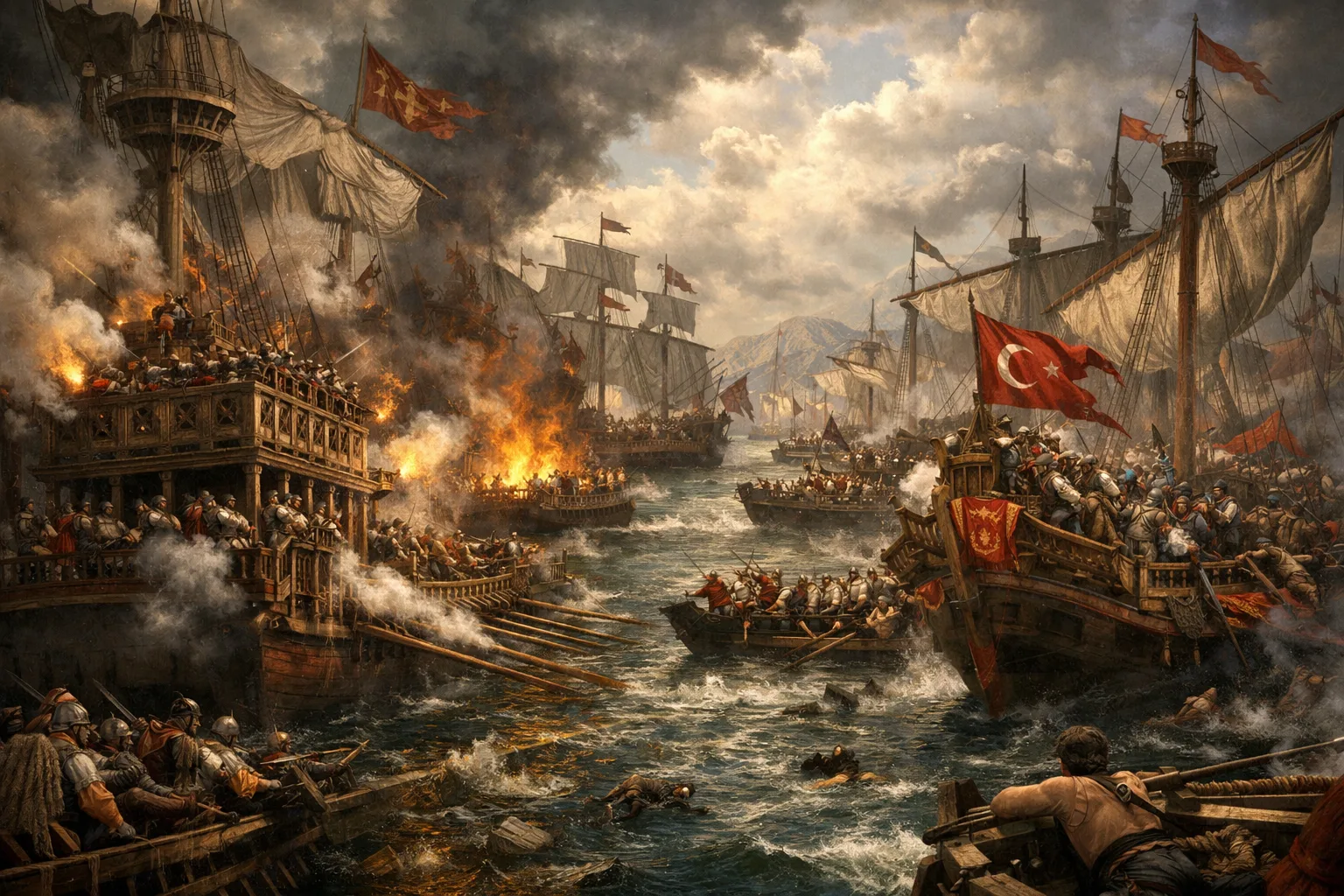
The Battle Of Lepanto 1571 was a four-hour clash that echoed across courts, ports, and pulpits. It pitted the Holy League against the Ottoman fleet in the Gulf of Patras, and it ended the long myth of Ottoman invincibility at sea. The stakes had been rising since 1453, when the city fell in our Fall of Constantinople investigation. Venice, whose maritime statecraft once pioneered quarantine and lazaretti, as seen in Venice’s early public health boards, now faced a strategic test: hold trade routes, defend Cyprus, and preserve balance in the Mediterranean.
Historical Context
From Cyprus to a Holy League
Cyprus sat at the hinge of commerce and coercion. Ottoman expansion pressed Venice from the east, while Spain guarded western sea lanes. Pope Pius V brokered a league of uneasy allies: Spain, Venice, the Papal States, Genoa, and smaller Italian forces. The alliance was improvised, but the reason was clear. The Ottoman fleet’s momentum, honed over a century of littoral warfare, threatened Christian shipping and prestige. The backdrop included centuries of imperial adaptation, explained in Byzantine resilience across centuries. That institutional memory shaped both diplomacy and doctrine, even after Byzantium’s fall.
When Famagusta capitulated and Nicosia fell, war aims sharpened. The Holy League assembled at Messina under Don John of Austria. Commanders argued over formation, reserves, and scouting, but they agreed on one principle: force a decisive engagement. The Battle Of Lepanto 1571 became the chosen trial. It would test coalition logistics, doctrine, and the will to coordinate a mixed fleet under a single signal.
Galleys, Guns, and Maritime Geography
Sixteenth-century Mediterranean warships were mobile platforms for infantry and artillery. Galleys carried dense bow guns and soldiers for boarding. Venice added a wildcard: the heavy galleass, a slower, broader vessel mounting guns on the sides and prow. Geography mattered as much as iron. The narrows near Lepanto funneled fleets into predictable lanes, making first contact and formation discipline decisive. Wind and current could tilt advantage, but oars gave commanders tactical agency. In this theater, speed to contact and the timing of reserves often beat raw numbers. That logic set the stage for everything that followed.
Key Facts and Eyewitness Sources
The Armies, the Line, the Leaders
The Holy League sailed in four elements: a left under Agostino Barbarigo, a center under Don John, a right under Gian Andrea Doria, and a reserve under Álvaro de Bazán. Opposite them stood Müezzinzade Ali Pasha in the center, Mehmed Sirocco on the Ottoman right, and Uluç Ali on the left. Numbers vary by source, but the line of battle was vast on both sides. For a crisp primer on commanders, deployment, and outcome, see the Encyclopaedia Britannica overview of the battle. The Battle Of Lepanto 1571 unfolded as a duel of centers with cascading wing crises.
Juan de Austria kept his flagship Real near the Venetian galleasses, which were posted forward of the Christian line to disrupt the Ottoman approach. Captains briefed soldiers to avoid premature firing, then close and board. Ottoman commanders planned to absorb the galleass shock, press the center, and fold the wings. The opening minutes confirmed how doctrine and discipline translate into momentum.
Eyewitness Voices and Material Clues
We hear the day through letters, diaries, and later reconstructions. Venetian reports describe the roar of the galleasses and the sudden slewing of enemy files. Spanish accounts dwell on boarding, banners, and the fight for Ali Pasha’s flagship. Cervantes, wounded in the battle, called Lepanto the “most high occasion” of his life. Muster rolls, prize lists, and later inventories of captured guns give material texture. Modern seabed surveys of the Gulf of Patras add context by mapping currents and likely wreck zones. Together they form a layered record: logistics, morale, and metal intertwined.
Analysis / Implications
Why the Result Mattered
The Battle Of Lepanto 1571 did not reverse the loss of Cyprus, nor did it end Ottoman naval power. Istanbul rebuilt its fleet within a year. Yet Lepanto shattered the aura of inevitability and recalibrated risk. Coalition warfare proved it could concentrate resources, harmonize signals, and win in a theater long dominated by Ottoman initiative. The victory echoed through courts and markets. Marine insurance rates moved; recruitment and morale rose. For a strategic reading that situates Lepanto inside Mediterranean systems, see the classic Past & Present essay by Andrew C. Hess.
Technology mattered, but not alone. Galleasses were force multipliers because they were positioned well and protected by doctrine. Infantry quality and command unity amplified their effect. The win was not a miracle of machines. It was the sum of formation, timing, and combined arms. This point counters easy “turning point” clichés and aligns with a broader view of change explored in Renaissance turning-point myths, where networks, not single inventions, drive outcomes.
Finance, Labor, and the Battle’s Afterlife
Rowing fleets burned money. Oarsmen needed pay and provisions; soldiers needed powder, pikes, and prizes. States used credit networks to turn taxes into hulls and wages. After Lepanto, that machinery had to run again, because peace was not guaranteed. The Battle Of Lepanto 1571 became a fundraising story as well as a victory story. Religious festivals, paintings, and poems converted success into legitimacy. Venice bargained from a position of honor, but also from fatigue. Spain celebrated, yet watched Flanders and the Atlantic with equal care. Strategy is always a portfolio.
Case Studies and Key Examples
The Venetian Galleasses Open the Fight
Six galleasses sat ahead of the Christian line like floating gun platforms. Their broadside fire disordered advancing Ottoman files and forced evasive maneuvers. That disruption blunted the first rush and slowed the center’s cohesion. The effect was part physical, part psychological. Enemy captains faced a problem they had not yet solved at scale: how to close under heavy, multi-angle fire without losing formation. The lesson is simple. A weapon’s value depends on where you place it and how you cover it. The Battle Of Lepanto 1571 made that lesson visible to every fleet in Europe.
The Center: Boarding, Banners, and a Breakthrough
At the heart of the mêlée, Don John drove Real into the Ottoman flagship Sultana. The fighting was brutal and close. Once Ali Pasha fell and his banner was taken, morale sagged across the Ottoman center. Command chains in galley battles are exposed; kill or capture the flagship, and signals die with it. The collapse rippled outward. Christian captains turned from survival to exploitation, freeing thousands of enslaved rowers as they captured hulls. Shock, then drift toward rout—this sequence appears in many age-of-oar battles, where the line is a fabric and the flagship its knot.
The Right Wing: Doria’s Detour and Uluç Ali’s Gambit
On the Christian right, Doria stretched his line to avoid being outflanked. Uluç Ali saw space and struck. He broke into the seam, mauled isolated squadrons, and threatened the rear. For a tense hour, the battle hinged there. Then Bazán’s reserve arrived, restoring alignment and sealing off the penetration. This episode shows how initiative can win a wing and still lose a war if the center fails. It also clarifies a perennial rule: reserves decide. When and where they commit can reverse a local disaster or turn advantage into victory.
The Left Wing: Sirocco’s Push and Barbarigo’s Defense
Sirocco attacked hard along the Christian left, seeking to pin Barbarigo against shoals. The Venetians held under terrible strain; Barbarigo fell to an arrow. Local victory on the flank did not translate into strategic gain because the center was breaking. Once the Ottoman flagship fell, the left’s momentum ebbed. Many ships grounded or were taken. The Holy League’s endurance in this sector owed much to drill and mutual support. Galley warfare rewards units that can rotate, reinforce, and keep morale when oars slow and decks turn slick. The Battle Of Lepanto 1571 etched that into memory.
The Reserve and the Turn of the Tide
Álvaro de Bazán’s reserve was the fleet’s shock absorber. He shored up the right when Uluç Ali surged and helped close the trap as the Ottoman center unraveled. Reserves are insurance against chance—rogue wind shifts, sudden gaps, or brilliant gambits by an enemy wing. At Lepanto, the reserve converted survival into exploitation, allowing organized pursuit and the rescue of captives. This is where the numbers diverge by source, but the pattern stands: hundreds of enemy galleys lost or captured, and many thousands of enslaved rowers freed. The reserve made the difference between a narrow win and a crushing one.
Sea Power in Comparative Perspective
Lepanto’s logic—use terrain, hold formation, strike the center—has older cousins on land. Think of how passes and narrows shape outcomes. For a useful foil, consider coalition warfare and terrain at Thermopylae and the follow-on gamble at Salamis, discussed in our piece on lessons from Thermopylae and Salamis. Different centuries, similar math: lines, flanks, and reserves. The Battle Of Lepanto 1571 capped the age of oars in the West and previewed how gun platforms would rule sea lanes in centuries to come.
Conclusion
Lepanto did not redraw every map, but it reset expectations. It proved that coalitions could fight as one, that doctrine could tame chaos, and that prestige could swing markets as surely as cannons swing battles. The Ottoman state adapted and endured, just as empires often do in long cycles that our Roman Empire rise and fall investigation explores across ages. Venice, seasoned by trade and institutions, returned to bargaining and rebuilding, a civic culture captured in our portrait of a Venetian world traveler. The Battle Of Lepanto 1571 remains a case study in preparation, leadership, and the power of narrative after the guns fall silent.