World Cold Deserts Explained: Why Antarctica Is A Desert
World Cold Deserts Explained may sound counterintuitive, yet it describes a simple truth: deserts are defined by dryness, not heat. Antarctica, the coldest place on Earth, receives scant precipitation and loses moisture to brutal winds. That makes it a textbook desert. Misconceptions about erosion and climate linger, as seen in the nuanced Sphinx erosion debate. Curiosity about extreme environments also fuels stories of human journeys, from ice-choked seas to barren plains, like those chronicled in a rigorous Vikings exploration timeline. In this guide, we unpack the science, the history, and the striking examples that clarify why the world’s coldest continent is, in fact, a desert.
Scientific and Historical Context
Deserts are places where the atmosphere gives very little water back to the surface—usually less than about 250 millimeters of precipitation per year. Temperature is secondary. A hot desert like the Sahara and a polar desert like the interior of Antarctica can both be arid by this measure. What makes Antarctica special is how dryness and cold reinforce each other. Cold air holds less moisture, so snowfall is rare in the interior. When it does fall, it often sublimates—turns straight from ice to vapor—under the push of relentless katabatic winds rushing downslope from the high polar plateau.
Explorers and scientists have long noted this paradox. Early expeditions measured meager snowfall far from the coasts. Satellite-era observations later mapped vast zones of extreme aridity across East Antarctica. In other words, the heart of World Cold Deserts Explained lies in the water budget: inputs are tiny, and losses are efficient. Add intense winds, low humidity, and the strong surface albedo that cools the boundary layer, and you have the perfect recipe for a dry climate locked in ice.
Key Facts and Eyewitness Sources
First, desert status depends on precipitation and evaporation/sublimation, not dunes or heat. You can stand on blue ice under a pale sun and still be in a desert. Second, the Antarctic interior is a moisture “starvation” zone; the nearest open water that could feed storms is far away, and the polar vortex tends to isolate the air mass. Third, katabatic winds accelerate drying by scouring snow and promoting sublimation.
Observers—from early sledging parties to modern station logs—consistently describe brittle air, diamond-dust ice crystals, and long stretches with no fresh snowfall. For plain-English datasets and maps on polar climate and snow, the National Snow and Ice Data Center is a trusted gateway to studies and visuals. A helpful general overview of the continent’s geography and climate can be found in the Britannica entry on Antarctica. A good way to grasp World Cold Deserts Explained is to separate dryness from temperature. Once you do, the polar plateau’s desert status becomes obvious.
Analysis / Implications
Seeing Antarctica as a desert reframes several debates. Desertification isn’t only about spreading sand; it is about net water stress, regardless of temperature. In polar deserts, most surface liquid water exists briefly—during sunlit summers, under wind-sheltered rocks, or in melt streams that vanish quickly. That matters for life, for geologic processes, and for how we read climate signals in ice cores.
Through the lens of World Cold Deserts Explained, climate projections gain nuance. Warming can slightly increase air moisture capacity and coastal snowfall, yet interior aridity may remain because circulation barriers and katabatic dynamics persist. Wind-driven sublimation will still compete with gains from any extra snowfall. Dryness shapes landscape evolution too. Wind abrasion, salt weathering, and freeze–thaw chipping slowly carve exposed rock, leaving pavements and ventifacts that resemble high-altitude or Martian terrains.
Case Studies and Key Examples
Antarctica’s Interior: The Polar Plateau Desert
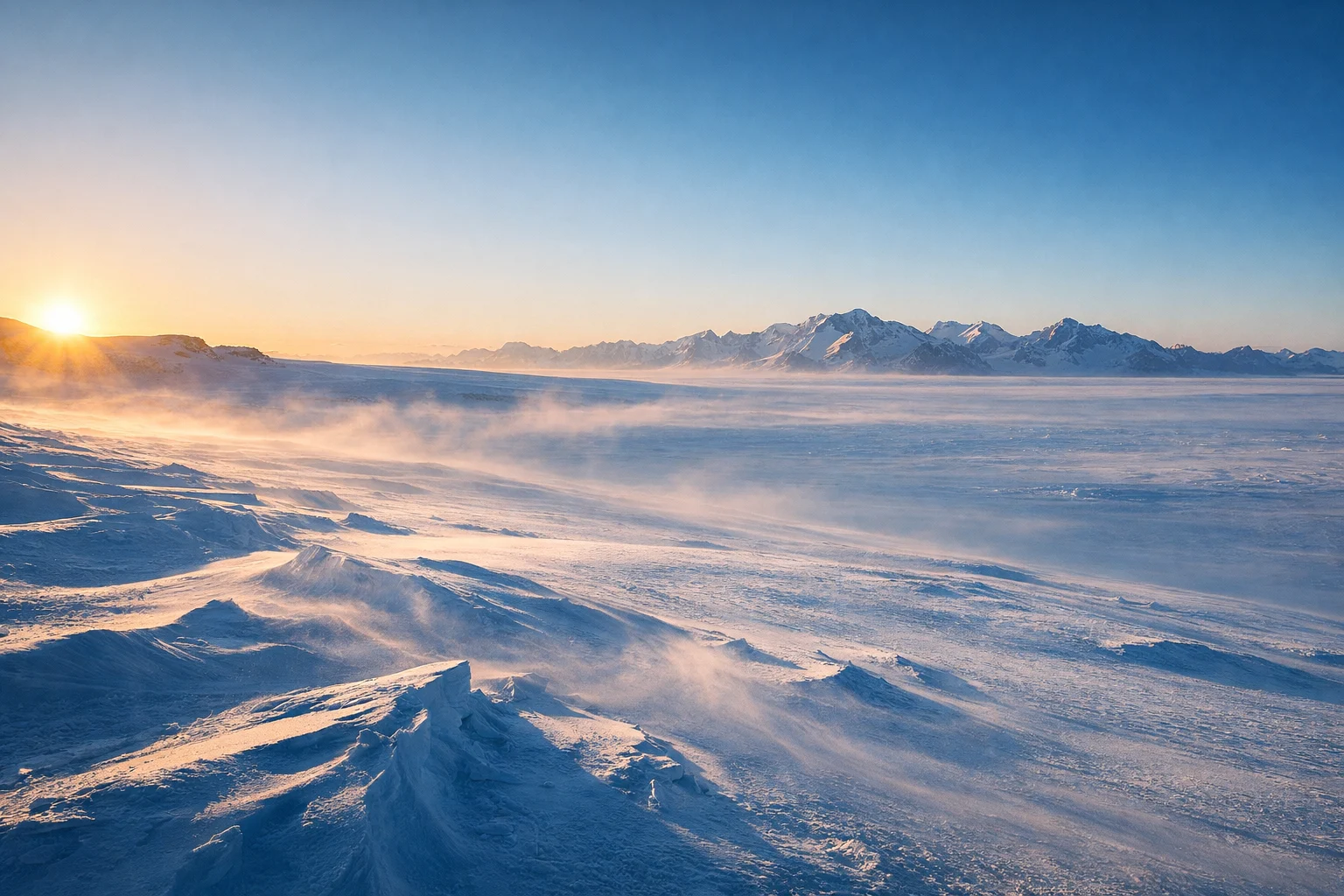
The East Antarctic plateau is the archetype of a polar desert. Annual precipitation is extremely low, often measured in tens of millimeters of water equivalent. Air is cold, thin in moisture, and capped by a temperature inversion that sustains katabatic winds. Long residence times for surface snow mean individual flakes may persist for centuries, compacting into firn and then ice. This is World Cold Deserts Explained in its purest form: low input, steady loss, and a landscape that looks static but is in subtle motion—snow drifting, crystals metamorphosing, and ice creeping toward outlet glaciers.
McMurdo Dry Valleys: Hyperaridity Without Sand Dunes
The McMurdo Dry Valleys near the Ross Sea are among Earth’s most hyperarid places. Many surfaces there receive so little moisture that liquid water is rare even in summer. Wind can loft ice crystals, polishing rocks into ventifacts. Despite the name “desert,” you won’t find classic dunes here; instead you see patterned ground, cold-based glaciers, and saline lakes capped by ice. Scientists study these valleys as analogs for Mars because the dryness, cold, and wind-driven erosion mimic processes on the Red Planet. The Dry Valleys epitomize World Cold Deserts Explained: a desert defined by water scarcity, not heat.
Arctic Polar Deserts: High Latitudes, Same Logic
Polar deserts also exist in the Arctic—on parts of Ellesmere Island and in the High Arctic archipelagos—where annual precipitation is very low and temperatures remain below freezing for most of the year. Summer thaws are brief. Mosses and lichens cling to rock in scattered patches, proving that life needs only thin pulses of liquid water. Here, as in Antarctica, the key is the balance of inputs and losses. The same dryness logic that guides World Cold Deserts Explained applies from pole to pole, even though the Arctic has more sea-ice edges and seasonal open water that can seed coastal precipitation.
Cold Coastal Deserts and Winds: The Humboldt Example
Not all cold deserts are polar. Along some coasts, cold ocean currents stabilize air layers and suppress rainfall. The subtropical Atacama has stretches so dry that parts function like a cold coastal desert at night and in winter, with marine fogs rather than rain. Upwelling keeps air cool and stable, while mountains block inland moisture. This isn’t polar, but it echoes the same dryness geometry—meager inputs, persistent losses, and winds that reshape the ground. Such examples underline World Cold Deserts Explained as a global framework for understanding aridity in many climates.
Human Narratives in Dry, Cold Lands
Extreme dryness molds human stories too. Volcanic aerosols once chilled skies worldwide; the cooling that followed Krakatoa’s 1883 eruption altered weather patterns and public imagination about climate. In remote Siberia, the Tunguska explosion left a treeless scar studied for decades, reminding us how fragile cold ecosystems can be. Deserts also shape routes. Travelers like Marco Polo’s route across Central Asia crossed steppe and desert corridors, while Zheng He’s voyages navigated monsoons and currents where dry coastal belts meet the sea. Each vignette reinforces the core insight: dryness organizes landscapes and lives.
How Antarctica Meets Desert Criteria
Checklist thinking helps. Low precipitation? Yes—much of Antarctica’s interior receives very little snow, with greater amounts only near the moisture-rich coasts. High evaporation or sublimation relative to inputs? Yes—strong winds and low humidity erode the snowpack from above even in deep cold. Sparse vegetation? Yes—only hardy microbes and lichens persist outside small oases or penguin-rich coasts. Eolian processes? Yes—wind sculpts surface snow into sastrugi, moves ice crystals, and abrades exposed rock. Viewed together, that is World Cold Deserts Explained applied step by step: Antarctica satisfies desert metrics while remaining Earth’s great ice storehouse.
Life and Geology in Polar Deserts
Life survives in thin niches: microbial mats beneath translucent rocks, algae in brine channels, and lichens tucked into sunlit cracks. Water appears briefly as melt or brine, then vanishes again. Geology advances slowly. Freeze–thaw cycles pry apart grains, permafrost heave makes polygons, and salt crystallization etches surfaces. These processes work on glacial timescales, yet they leave unmistakable textures. For researchers, World Cold Deserts Explained is more than a label; it’s a field guide to which processes dominate when water is the scarcest ingredient of all.
Frequently Misunderstood Points
“There’s snow, so it can’t be a desert.” Snow presence says little about annual water budget. In Antarctica, snowfall is scarce, and most of the surface moisture is old snow compacted into ice, not fresh accumulation. “Deserts must have dunes.” Many don’t. Rock pavements, salt flats, and wind-sculpted ice all fit the eolian bill. “Warming will end the polar desert.” Not necessarily. Warmer air can hold more moisture, but circulation patterns, inversions, and winds can keep interiors arid even if coasts get wetter. These clarifications keep World Cold Deserts Explained focused on the correct variable—aridity.
Conclusion
Antarctica is a desert because it is profoundly dry. Low precipitation, efficient sublimation, and fierce winds maintain a negative water budget across vast interior tracts. That dryness drives the region’s geology, ecology, and ice dynamics. It also reframes how we think about deserts worldwide, from polar plateaus to cold coastal belts shaped by upwelling. Understanding this helps us read climate records and anticipate change where water is rare but consequential.
If geography and climate shape deserts, they also steer human choices. Resource decisions, like those that culminated in the Deepwater Horizon blowout, show how fragile environmental balances can be. Grand strategy, as in the era when Napoleon sold Louisiana, reminds us that landscapes constrain power. Keep the lens of World Cold Deserts Explained handy: it clarifies why the iciest continent belongs in the global desert family.