Ghana Empire Gold Trade: How West Africa Set Prices
The Ghana Empire Gold Trade shaped Mediterranean money and African markets for centuries. This was not luck. It was policy, geography, and refined bargaining. Caravans crossed the Sahara with salt, cloth, and copper. They returned with dust and nuggets that mints prized. To picture the broader web of exchange, compare the Silk Road trade network. For African statecraft and stability over long horizons, see how Egypt’s political longevity rested on rules, surplus, and ritual. Ghana’s rulers used similar logic but applied it to movement, prices, and the goldfields at the edge of the savanna.
Historical Context
From Wagadu to Kumbi Saleh
Arabic geographers called the state “Ghana,” a title of kings ruling Wagadu. Power clustered near Kumbi Saleh, a twin-town capital. One town held the court, treasure, and ritual. The other hosted merchants and judges. Camel traffic swelled each dry season. The court taxed every convoy that entered. That predictable revenue armed, fed, and paid the realm. For an accessible overview of the polity and its place in trans-Saharan exchange, consult Encyclopaedia Britannica’s article. Caravans linked Sahelian hubs and desert oases into a reliable fiscal machine.
Salt Roads, River Crossings, and Neighboring Networks
Gold moved north; salt moved south. The routes ran through oases like Awdaghust and Ijil and across river crossings of the Senegal and Niger. The state sat between forest-edge goldfields and the Sahara’s tollgates. That position let rulers meter flows. Ghana’s neighbors mattered, too. Nubian corridors tied the Nile to the Red Sea, a context sketched in this note on caravan and river routes across Nubia. Sea lanes also shaped prices. Levantine brokers and shipowners set tastes and demand patterns, as explored in a guide to Phoenician sea routes. West Africa priced gold with desert math, yet Mediterranean appetite completed the equation.
Key Facts and Eyewitness Sources
What Arabic Geographers Actually Reported
Writers like al-Bakri (11th century) described Ghana’s twin-city capital, royal court, and regulated markets. Ibn Hawqal and al-Idrisi traced caravan legs, taxes, and the rhythm of seasons. They emphasized rules: stable tolls, set weights, and the protection of merchants. Some accounts mention “silent trade” at forest edges. Drums, gongs, and gestures replaced speech when strangers distrusted one another. The precise details vary with the author. Yet a pattern holds. Ghana used institutions to make strangers cooperate. Traders paid, waited, and accepted posted terms because protection and predictability made the journey profitable.
How Prices Were Made on the Desert’s Edge
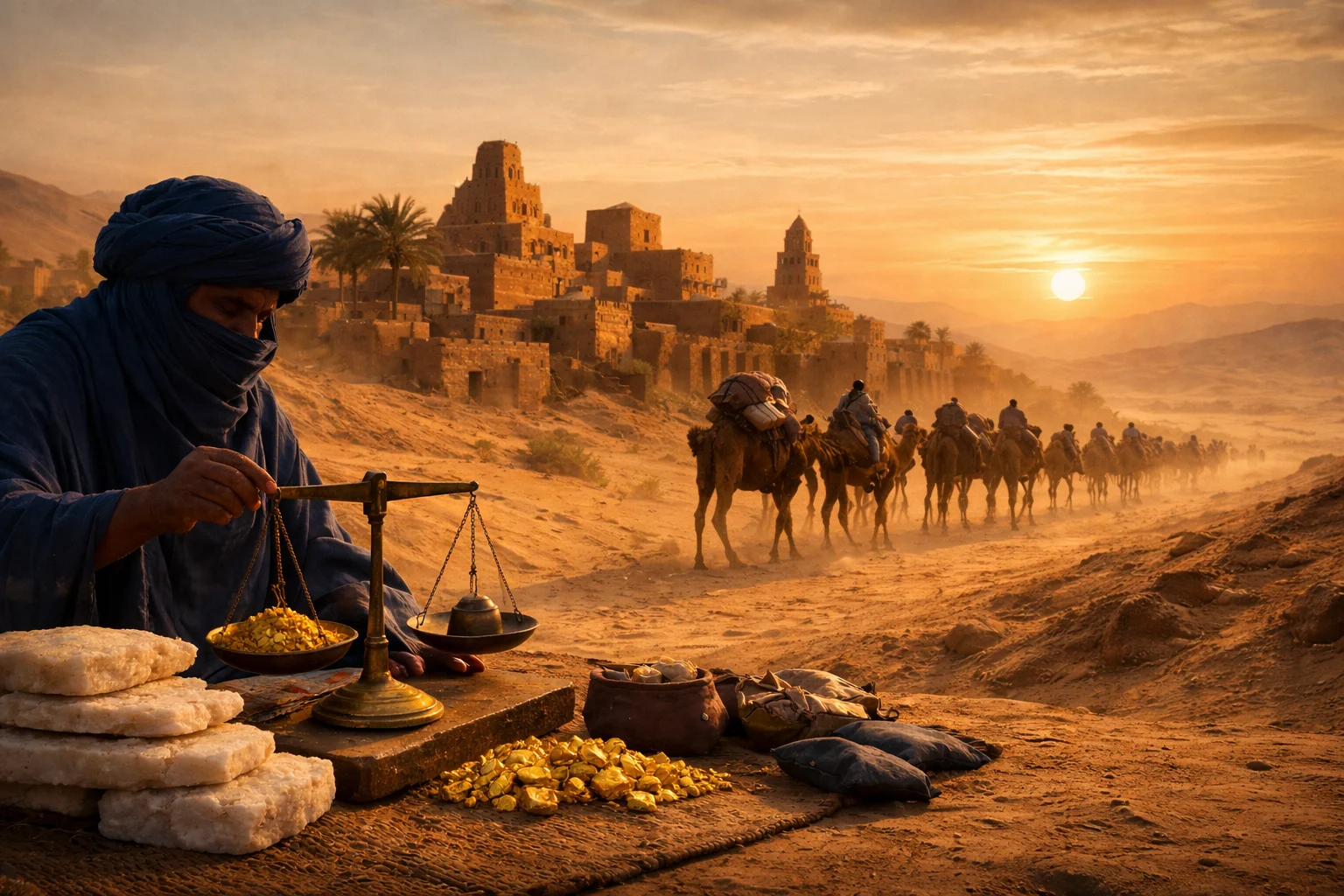
Ghana did not mint coin for export. It controlled scarcity at the source. Courts taxed every camel load and sometimes reserved large nuggets as royal property. Commoners traded dust, measured with scales and standard weights. North African mints then turned that metal into dinars. Museums and historians summarize how this gold reshaped Mediterranean coinage; a clear primer is the Met’s essay on the Saharan gold trade. Sea demand, desert cost, and court rules met at market stalls. The result was a price corridor that held year after year, even as routes shifted.
Analysis / Implications
Price Power Without Minting a Coin
The Ghana Empire Gold Trade shows that price power can come from logistics, not currency. The state never needed to flood markets with coin. It rationed what left the forest edge and taxed passage. Scarcity kept prices high. Trust kept trade flowing. Other empires achieved price influence by minting iconic coins, such as the Achaemenid daric. For a concise background on that monetary toolkit, see this note on gold daric and imperial minting. Ghana achieved similar outcomes by managing the pipeline instead of the die.
Institutions, Credibility, and the “Tax for Protection” Model
Prices held because rules held. Caravans accepted tolls when guards deterred raids and judges enforced contracts. Merchants accepted posted weights when fraud was punished. Money also needed a second layer of credibility in destination markets. That is why coin-based states prized West African gold. Stable mints turned bullion into widely trusted means of payment. For a comparative lens on how coinage and law underpin long-distance exchange, consider this study of Byzantine coinage and trust. Ghana’s lesson is simple: institutions, not miracles, keep prices legible across deserts.
Case Studies and Key Examples
Silent Trade as a Pricing Device
At forest margins, producers and brokers sometimes traded without words. One side laid gold dust on a cleared patch and stepped back. The other added salt or cloth until both sides were satisfied. Signals, not haggling, closed the deal. This was not theater. It solved a real problem: exchange among strangers without a shared language or legal forum. The method also disciplined prices. Sellers made offers in measured dust. Buyers answered with standardized blocks. Over repeated cycles, communities learned the going rate. The Ghana Empire Gold Trade thus included a ritual that doubled as price discovery and trust-building.
Kumbi Saleh and the Tax That Set the Floor
Al-Bakri described a royal town and a nearby Muslim quarter with markets, judges, and scholars. Caravans paid entry taxes per load. The schedule was known in advance. That predictability made margins calculable. A merchant could price salt at source, add expected tolls, and estimate profits at Kumbi. The tax itself set a floor under prices, preventing ruinous undercutting during glut years. It also funded escorts that reduced losses. With fewer thefts, uncertainty shrank, and volatility fell. The Ghana Empire Gold Trade did not “fix” prices. It made the corridor safe enough that prices converged and stayed within ranges traders trusted.
Conclusion
Ghana’s rulers never controlled the sea. They controlled time, distance, and risk. They taxed loads, guarded routes, and stabilized measures. That framework turned seasonal caravans into a predictable market. North African mints then translated dust into coin. The process aligned incentives from forest edge to port. Even when routes shifted, the logic endured into later empires. Price setting was not a royal proclamation. It was a corridor working well.
If you want to compare overland price discipline under a different regime, read how Mongol-made safe lanes synchronized markets across Eurasia. For a classic example of state capacity shaping exchange, see how roads, coinage, and law built a continental economy. The Ghana Empire Gold Trade belongs in that same conversation. It shows how institutions, geography, and prudent scarcity can set prices without minting a single coin of your own.