How the 1973 Oil Embargo Impact Rewired the Global Energy Economy
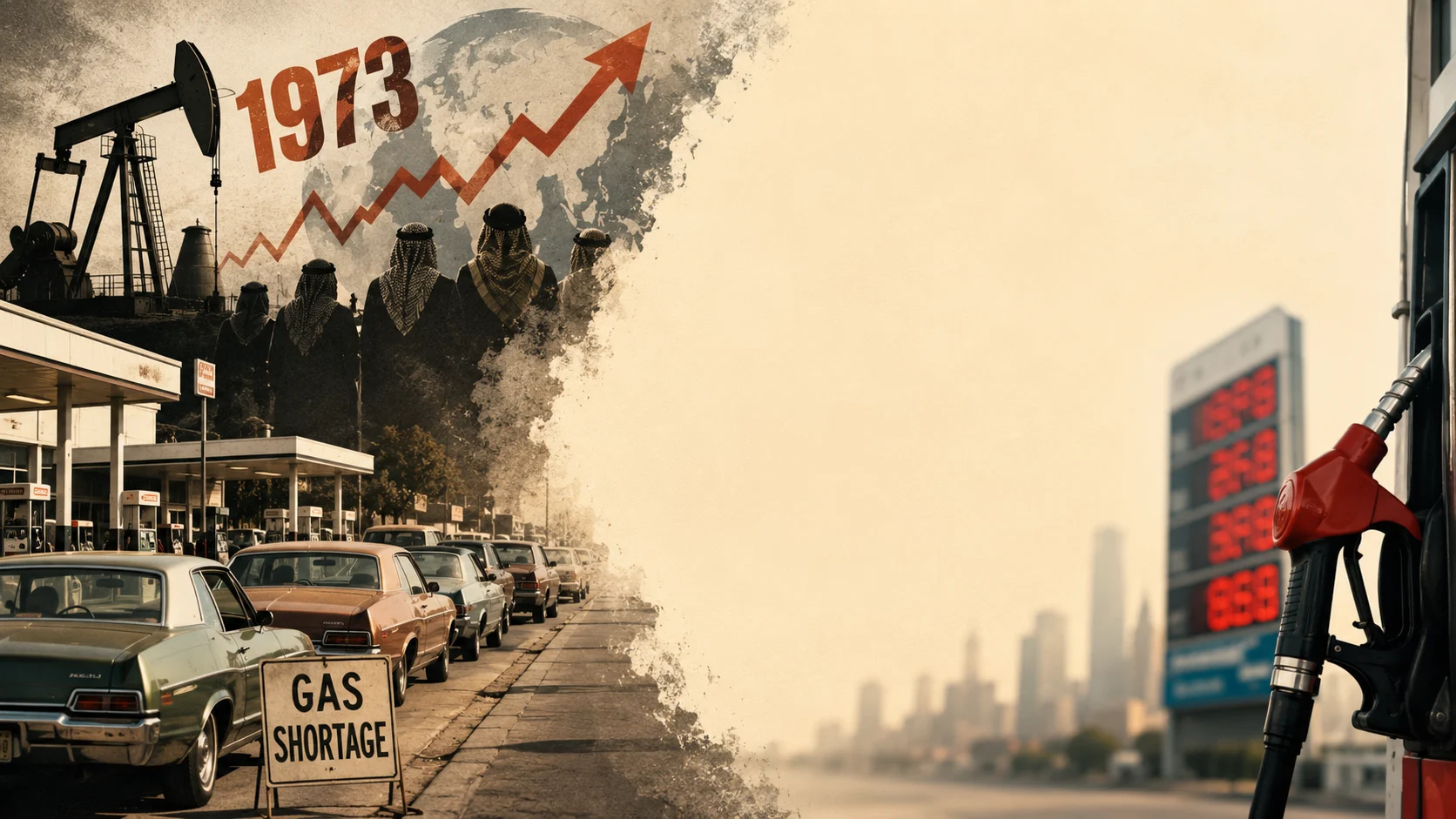
The 1973 oil embargo impact didn’t end when Arab nations lifted the export ban in March 1974. It seeped into pipelines, policy halls, and household budgets, where it has quietly remained ever since. Within five months, crude oil prices quadrupled. Inflation surged. Queues at gas stations stretched for city blocks. Half a century later, the structural changes that crisis forced upon Western economies continue to dictate how energy is priced, traded, and secured — and why your gas bill today still carries echoes of a geopolitical decision made in October 1973.
The World Before the Embargo: A Landscape Built on Cheap Oil
To understand why the shock was so profound, you first need to picture the energy landscape of the early 1970s. Oil was astonishingly cheap. The average U.S. retail price for a gallon of regular gasoline hovered around 38 cents in 1972 — roughly $2.70 in today’s money, adjusted for inflation. Entire industries, suburban housing patterns, and foreign policy assumptions rested on the premise that petroleum would stay affordable indefinitely.
The United States had been the world’s dominant oil producer since the late 19th century, but domestic output peaked in 1970. That single geological fact — American production hitting its ceiling — left the country increasingly dependent on imports, particularly from the Persian Gulf. Europe and Japan were even more exposed, importing the vast majority of their crude.
Meanwhile, the Organization of Arab Petroleum Exporting Countries (OAPEC) had been quietly accumulating leverage. Western oil majors — the so-called “Seven Sisters” — had long dictated contract terms to producing nations. But nationalizations in Libya, Iraq, and elsewhere signaled a turning tide. Producers were reclaiming control. What few Western governments fully appreciated was how swiftly that leverage could be weaponized.
This fragility mirrors other geopolitical chokepoints that history has repeatedly exposed. Just as the Suez Canal’s nationalization in 1956 scrambled European trade routes, the oil embargo demonstrated that commodity flows are never truly insulated from politics. Infrastructure and resources that seem permanent can shift overnight when the right pressure is applied.
October 1973: The Trigger, the Embargo, and the Numbers
On October 6, 1973, Egypt and Syria launched a coordinated surprise attack on Israeli positions in the Sinai Peninsula and the Golan Heights — the Yom Kippur War. The United States responded with an emergency military airlift to resupply Israel. Within days, OAPEC announced a total oil embargo against the U.S. and other nations it deemed supporters of Israel, including the Netherlands and Portugal.
The data tell a stark story. The posted price of Arabian Light crude rose from $3.01 per barrel in October 1973 to $11.65 by January 1974 — a 287% increase in three months. According to figures compiled by the U.S. Energy Information Administration (EIA), real gasoline prices in the United States nearly doubled between 1973 and 1974, triggering the worst peacetime inflation Americans had experienced since World War II.
GDP in OECD nations contracted sharply. The Dow Jones Industrial Average lost nearly 45% of its value between January 1973 and December 1974. Unemployment rose across Western Europe and North America. These weren’t abstract statistics — they were job losses, mortgage defaults, and shuttered factories. The International Energy Agency (IEA), founded in 1974 directly in response to the crisis, later estimated that the embargo cost the global economy the equivalent of hundreds of billions of dollars in lost output.
Strategic Oil Reserves: A Direct Policy Response
One of the most concrete institutional legacies of the embargo is the Strategic Petroleum Reserve (SPR), authorized by the U.S. Energy Policy and Conservation Act of 1975. The SPR stores hundreds of millions of barrels of crude in underground salt caverns along the Gulf Coast. Its explicit purpose is to cushion future supply shocks — a direct acknowledgment that 1973 could happen again. When the SPR is tapped today, as it was in 2022 in response to the Ukraine war’s effect on energy markets, that mechanism traces its existence directly to the 1973 embargo.
The Structural Changes Nobody Reversed
Crises often produce temporary fixes that fade when the pressure lifts. The 1973 oil shock was different. It triggered structural changes so deep that many of them have never been unwound — and a few have calcified into permanent features of the global energy system.
The first and most durable change was the shift in pricing power. Before 1973, oil prices were essentially set by Western companies. After the embargo, OPEC effectively became the price anchor for global crude markets. That transfer of power has never been fully reversed. Even today, an OPEC production decision in Vienna can move gasoline prices in Kansas within weeks. The parallel is instructive: just as the French Revolution’s metric system rewired everyday measurement permanently, the 1973 crisis permanently rewired who controls the energy dial.
The second major structural shift was the financialization of oil. Crude oil futures contracts — the mechanism that allows traders, airlines, and refiners to hedge against price volatility — were introduced on the New York Mercantile Exchange in 1983, but their conceptual foundation was laid by the price chaos of 1973–74. Today, vastly more paper barrels trade daily than physical ones. This financial layer adds volatility but also transmits price signals globally at lightning speed, meaning a supply disruption in one region ripples into your local pump price within days.
Third, energy security became a core component of national defense strategy. The Berlin Airlift had already shown how logistics could be weaponized in Cold War confrontations, but the oil embargo proved that commodity access was as strategically vital as military hardware. This realization hardened into doctrine. The U.S. Carter Doctrine of 1980, pledging military force to protect Persian Gulf oil flows, was a direct descendant of 1973’s lessons.
Energy Policy Trends That Trace Back to the Embargo
Fifty years of energy policy in the industrialized world can be read as an extended response to the trauma of 1973. The trends are measurable, documented, and still unfolding.
Fuel efficiency standards. The U.S. Corporate Average Fuel Economy (CAFE) standards, introduced in 1975, were a direct legislative response to the embargo. They pushed automakers to build more efficient vehicles. The average fuel economy of new U.S. cars roughly doubled between 1974 and 1985. Europe adopted similar frameworks. Without 1973, it is debatable whether these standards would have emerged at all — or at least not that quickly.
Nuclear power expansion. France, deeply alarmed by its near-total dependence on imported oil, launched the most aggressive nuclear construction program in history. By the 1980s, nuclear power supplied over 70% of French electricity — a proportion that holds today. The French model was explicitly designed to insulate the country from another embargo. Meanwhile, the long story of how electricity grids evolved from Edison and Tesla’s early rivalry shows that energy infrastructure always reflects the political anxieties of its era.
North Sea development. The embargo accelerated investment in offshore oil exploration. The North Sea fields, already identified in the late 1960s, received a massive injection of capital after 1973. Britain and Norway became significant producers, reducing European dependence on OPEC. Norway’s sovereign wealth fund — today the largest in the world — was seeded by North Sea revenues that the embargo helped unlock.
Renewables research. The U.S. government’s investment in solar, wind, and geothermal research increased sharply after 1973. The Solar Energy Research Institute (now the National Renewable Energy Laboratory) was established in 1977. The direct line from 1973 to today’s renewable energy sector is longer than most people realize.
Real Cases: How the Embargo Echoes in Modern Price Shocks
The 1973 template has repeated itself — with variations — in every subsequent major oil price shock. Understanding those repetitions helps decode today’s gas bills.
The 1979 Iranian Revolution removed roughly 4–5% of global oil supply from the market. Prices doubled again. The mechanism was identical to 1973: a geopolitical disruption translating into supply reduction translating into price spikes. The same OPEC pricing architecture, installed after 1973, amplified the shock.
The 1990 Gulf War produced a brief but sharp spike when Iraq’s invasion of Kuwait removed Kuwaiti and Iraqi production. The SPR was tapped for the first time — the direct use of a 1973-era institution to manage a 1973-pattern crisis.
The 2021–2022 energy price surge, driven first by post-pandemic demand recovery and then by the Ukraine war, followed the same structural logic. Russia’s role as a dominant natural gas supplier to Europe mirrored OPEC’s oil leverage in 1973. The European Union’s scramble to diversify gas supplies — signing LNG deals with Qatar, the U.S., and Norway — reprised the post-1973 diversification strategies in almost textbook fashion.
Even the U.S. Navy’s persistent carrier strike group presence in the Persian Gulf reflects the military doctrines crystallized after 1973. Those carrier groups exist, in significant part, to guarantee oil flow — a mission born from the embargo’s strategic lessons.
The Psychological and Cultural Footprint
Beyond policy and economics, the 1973 oil shock left a psychological imprint that shaped consumer culture in ways that are still visible. The American love affair with large, fuel-hungry vehicles was briefly interrupted. Compact cars flooded the market. Energy conservation became a civic virtue — President Nixon asked Americans to lower thermostats and reduce highway speeds.
The 55 mph national speed limit, imposed in 1974 primarily to save fuel, remained in place until 1995. For over two decades, it reshaped driving habits and highway design. The suburban sprawl model, predicated on cheap gasoline, came under the first serious intellectual scrutiny it had ever received. Urban planners began talking about walkability and transit as practical necessities, not just aesthetic preferences.
This cultural shift had parallels in other domains. Just as the anxieties of the Cold War era embedded new symbols into American civic life, the oil shock embedded energy consciousness into the national psyche. The difference is that energy anxiety never fully lifted — it simply modulated between crises.
The embargo also accelerated a broader questioning of American exceptionalism and invulnerability. The country that had powered the Allied victory in World War II — partly on the strength of its own domestic oil — found itself waiting in gasoline lines. That humiliation had political consequences. It contributed to the broader “malaise” narrative that defined the mid-to-late 1970s and helped propel Ronald Reagan’s “morning in America” message in 1980.
Future Outlook: Will the Embargo’s Shadow Finally Fade?
The transition to electric vehicles and renewable energy is often framed as a clean break from the oil era. In some respects, it is. But the structural vulnerabilities that 1973 exposed — dependence on concentrated resource supplies, geopolitical leverage over commodity flows, the speed with which supply shocks transmit into consumer prices — are not specific to oil. They are features of any concentrated resource system.
Lithium, cobalt, and rare earth elements for batteries are geographically concentrated in ways that echo the OPEC oil map. The Democratic Republic of Congo supplies over 70% of the world’s cobalt. China processes the majority of rare earths used in electric motors. The history of how large-scale energy infrastructure creates political power suggests that whoever controls critical mineral supply chains in the 2030s and 2040s will hold leverage analogous to what OPEC wielded in 1973.
According to the International Energy Agency’s transition reports, even under aggressive decarbonization scenarios, liquid fuels will remain a significant part of global energy consumption through at least 2035. The infrastructure, pricing mechanisms, and geopolitical arrangements built after 1973 will continue to function — and therefore continue to shape your gas bill — for another decade or more, even as the energy system slowly rewires itself.
The Dust Bowl’s agricultural catastrophe reshaped American demographics for generations; the 1973 embargo reshaped energy geopolitics for at least as long. The lesson embedded in both is the same: systemic shocks don’t end when the immediate crisis passes. They restructure the systems they strike, and those restructured systems then become the foundation on which the next era is built. The next time you fill your tank and wince at the price, you are, in a very real sense, paying a bill that was first issued fifty years ago — in a dusty October when oil became a weapon and the world learned it was not prepared.