Lascaux Cave Art Meaning: Why Did Ice Age Painters Go Deep?
Lascaux Cave Art Meaning has fascinated archaeologists, artists, and readers for decades. What drove people into dark, risky tunnels to paint animals with breathtaking grace? To approach the answer, we need context: how symbols encode rules as in the Hammurabi Code of Laws, and how humans celebrate meaning through monuments like the Seven Wonders of the Ancient World. In Lascaux, both impulses meet: rules for living and awe for the world. This article explains what the cave reveals about Ice Age minds, and why those painters went so deep.
Historical Context
A quick timeline and setting
About 17,000 years ago, during the late Upper Paleolithic, southwestern France was cold and changeable. Herds of horses, bison, and deer moved across open steppe. People followed rivers, seasonal pastures, and rock shelters. In that landscape, art appears not on village walls but far underground. Caves offered stable temperatures, quiet, and total darkness—conditions that turn light into a tool.
Climate swings shaped the backdrop. Sudden eruptions and atmospheric events can alter sunlight and seasons. Historical examples, like the far-reaching effects examined in research on the Krakatoa eruption of 1883, remind us how environments can shift perception and survival strategies. For Ice Age groups, watching herds and weather meant survival; painting them may have been part of that attentiveness.
Why go underground at all?
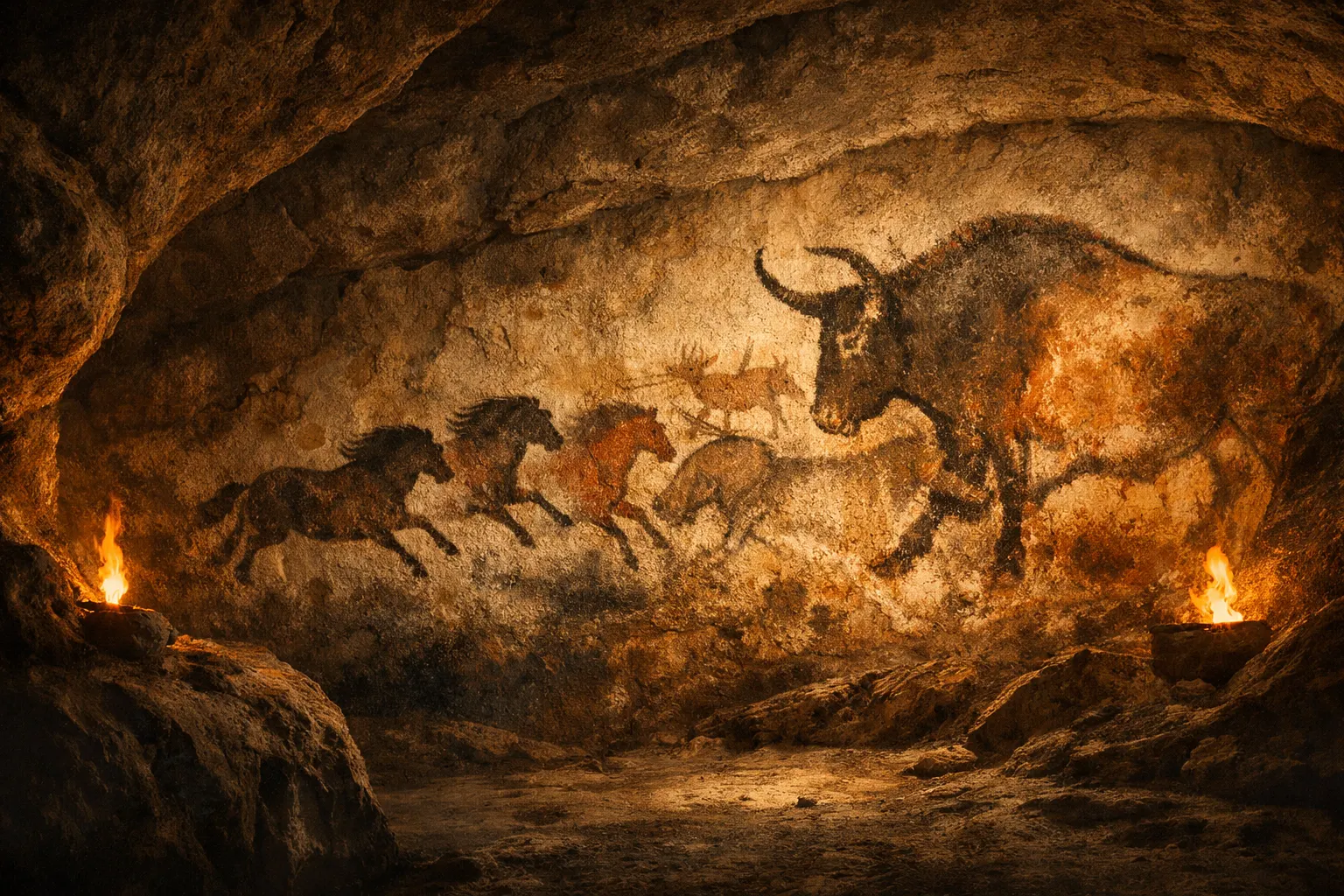
Going deep was hard. Painters crawled, climbed, and hauled lamps made from stone bowls with animal fat. Darkness creates a stage. Torchlight flickers. Uneven limestone turns flat drawings into moving forms. In that dark theater, images feel alive. “Lascaux Cave Art Meaning” starts here: a controlled environment where light and rock shape the message. Underground, sound behaves differently too; a chant or clap carries. The cave becomes not just a gallery, but a device—for focus, memory, and ritual—built from stone, silence, and flame.
Key Facts and Eyewitness Sources
Discovery, dating, and the site
Lascaux was discovered in 1940 by teenagers from Montignac. Soon, scholars documented hundreds of figures: horses, aurochs, deer, bison, ibex, and abstract signs. Radiocarbon dates and style comparisons place most paintings in the Magdalenian period. The cave’s decorated chambers—like the Hall of the Bulls and the Axial Gallery—combine life-size animals and dynamic compositions. Official listings such as UNESCO’s entry for the decorated caves of the Vézère Valley (UNESCO World Heritage) recognize their universal value.
Evidence is indirect. No written notes from the artists survive. Archaeologists assemble meaning from pigments, lamp soot, footprints, and tool marks. That detective work resembles the way scientists reconstructed the 1908 blast from scattered clues in the Tunguska explosion. Each fragment matters: charcoal flecks, calcite skins, dripstone growth, and the order of superimposed figures all inform the timeline and intent.
Inside the art and techniques
Artists used ochres, manganese, and charcoal. They engraved outlines, blew paint through tubes, shaded with pads of fiber, and exploited natural bulges to suggest volume. Many panels appear placed with care, aligning turns and niches with key scenes. For authoritative overviews, the French cultural portal provides accessible dossiers on Lascaux’s chambers (French Ministry of Culture). Within this record, certain motifs recur: herds in motion, confronting bulls, galloping horses, and signs like brackets and dots. Lascaux Cave Art Meaning emerges from this repeated visual grammar.
Analysis / Implications
What the images might have done
Three broad interpretations dominate discussions. First, “hunting magic”: painting prey to influence real hunts. Second, visual knowledge systems: maps of behavior or seasonal cycles, teaching tools about animal movement and safe routes. Third, ritual and altered states: images used during ceremonies, enhanced by darkness, echoes, and flicker. Lascaux Cave Art Meaning likely sits across these, varying by chamber and moment. The cave’s acoustics and light support all three: performance, instruction, and trance can coexist in a single space.
Light was not just for seeing; it was part of the message. Under flame, layered lines seem to animate a gallop. A viewer’s path turns into a storyboard. The cave shaped the narrative, guiding bodies past panels in a deliberate sequence. That design implies planning, shared norms, and roles—artists, torchbearers, initiates. Socially, such gatherings strengthen ties, transmit skills, and manage fear. Art helped bind groups that needed cooperation to survive.
What the images meant socially
Meaning also lives in rules and institutions. Think of archives and controlled access, themes explored in studies of the Vatican’s Secret Archives. A deep cave similarly restricts who sees what, when. That control can make knowledge precious and sacred. Lascaux Cave Art Meaning, then, includes power over information—a way to mark status, teach initiates, and preserve memory in times of stress. The cave served as a resilient “memory palace” during unstable climates, storing maps of animals, seasons, and stories as images embedded in stone.
Case Studies and Key Examples
Hunting magic vs. communication
Consider the Hall of the Bulls. Massive aurochs face in opposing directions, flanked by agile horses. If these were simple “wish lists” for hunts, we might expect more wounded prey, traps, or weapons. Instead, we see movement, pacing, and sometimes superimposed bodies. That composition looks like a lesson in behavior: how herds split, wheel, or stampede. Lascaux Cave Art Meaning, in this reading, is practical knowledge encoded as drama—a way to compress hours of observation into a single, memorable scene.
Abstract signs support the idea of notation. Brackets, dots, and bar-like marks could refer to times, counts, or places. While we cannot decode them, their repetition implies a system. Teaching such signs underground adds solemnity and focus. Students remember better when senses are heightened and distractions are gone. The cave’s environment thus amplifies meaning.
Ritual space, light, and sound
Another example is the Axial Gallery, where narrow walls force a single file. Torchlight makes beasts seem to surge forward. In such moments, image becomes experience. Ritual readings are plausible: songs, rhythmic steps, and call-and-response guided by echoes. The interplay of darkness and breath mirrors how modern disasters change perception. As the Great London Smog once altered what city dwellers could see, cave darkness reshaped how Ice Age people saw their own symbols. Lascaux Cave Art Meaning could therefore be performance—images activated by light and voice.
Sound marks certain chambers. Experiments in decorated caves show that handclaps and hums amplify in spots where paintings cluster. While not proof, the pattern is suggestive. Placement likely mattered for both sight and sound, turning the cave into an instrument.
Mapping, movement, and memory
Think too about paths. Reaching the right panel requires knowing turns, squeezes, and descents. Guiding others by lamplight turns space into a story: “We pass the running horses, then the falling bison.” The route becomes a mnemonic, a living map. Lascaux Cave Art Meaning may include wayfinding—an embodied atlas learned by repetition. That would explain clusters of motifs near junctions and the reuse of panels with strong relief. If the cave is a “memory palace,” those bulges and curves function as pegs, each storing a scene or rule for living.
Key Facts and Eyewitness Sources
Although no Ice Age diarist left instructions, we do have modern “eyewitnesses”: the discoverers of 1940 and early scholars who meticulously traced, photographed, and mapped the panels. Their field notes, molds, and rubbings preserve positions and overlaps now threatened by calcite blooms and microbial growth. The best curated summaries remain in official dossiers such as the UNESCO listing and the French Ministry of Culture portal, which document chambers, techniques, and conservation.
From these records, several points are secure. First, animal realism is astonishing; muzzle, tendon, and gait are naturalistic. Second, people appear rarely and schematically, which hints at rules about depicting humans. Third, placement is strategic: key panels occupy bends or vaults that maximize impact. All three inform Lascaux Cave Art Meaning: respect for prey, caution about human figures, and choreography of sightlines. We cannot read an exact “script,” but the staging is unmistakable.
Analysis / Implications
Resilience, pedagogy, and belief
What does this mean for understanding Ice Age minds? First, resilience. Communities facing uncertainty invest in institutions that stabilize memory. A cave filled with durable images is just that. Second, pedagogy. Images teach across language barriers and generations. In many hunter-gatherer societies, demonstration beats explanation; the cave transforms observation into narrative. Third, belief. Repetition and place make ideas “felt.” Lascaux Cave Art Meaning likely combined practical knowledge with rites that made that knowledge stick. It was learning made sacred.
We should avoid single-cause answers. Under different leaders or seasons, the same panel could serve a new purpose. What stays constant is the technology of meaning: flame, pigment, surface, and path. Those tools still work on us today. Visitors, even in replicas, report a hush and a shiver—the sense that pictures are acting on them. That is the mark of art designed for bodies moving through space, not for static walls.
Case Studies and Key Examples
Animals, signs, and sequences
Take a sequence where horses appear to accelerate across a curve. The panel reads like animation. Nearby dots may track sightings, phases, or ritual counts. None of this is random. Craftspeople returned to key walls, correcting or layering figures. Lascaux Cave Art Meaning, here, is process: preparing surfaces, testing lines, revisiting scenes. In that process, the cave gathered authority. Knowledge becomes convincing when it is repeated in the same place, under the same rules.
Another case is the rare “man and bison” scene, often read as a narrative with symbolic scaffolding. Whether hunt, trance, or myth, the staging is deliberate: a tight space, a focused light, and high contrast pigments. The viewer is forced to stop, shift posture, and attend closely. That embodied pause is part of the meaning machinery.
Conclusion
So, why did Ice Age painters go deep? Because the cave turns pictures into experiences and experiences into knowledge. Darkness and echo make a theater. Relief and flame give motion. Paths impose sequence and ritual. In that engineered environment, images teach, bind, and move people. That, in essence, is Lascaux Cave Art Meaning: a system that stores memory and power in stone, accessible through performance.
Humans have always built meaning with images and stories. Founding myths such as those retold in the legend of Rome’s origins or great religious reforms like those under Akhenaten in ancient Egypt show how visuals and narratives reshape worlds. Lascaux belongs to that long tradition. Its lessons endure: meaning is made where place, performance, and picture meet.