How Apollo program tech spinoffs quietly changed daily life
Apollo program tech spinoffs rarely make headlines, yet they shape the way we sit, sleep, work, and heal. The Moon race built methods and tools that later migrated into homes, hospitals, and factories. Its story is also about people and choices—how teams, supply chains, and ethics drive innovation. To see where the rocket era began, consider how Operation Paperclip shaped the early U.S. rocket effort. And to grasp why chips matter to every gadget today, note the Taiwan semiconductor rise story that followed decades of miniaturization Apollo helped accelerate.
Historical Context
From Saturn V to living rooms
In the 1960s, Apollo compressed a generation of engineering into a decade. That pressure forged habits: ruthless weight saving, fault tolerance, and extreme reliability. Programs like the Apollo Guidance Computer placed thousands of early integrated circuits into a single system. Procurement pushed suppliers to hit tighter tolerances and higher yields. When the program ended, those capabilities did not disappear. They diffused into civilian products, creating a quiet wave of value we now call Apollo program tech spinoffs.
This diffusion was not just about hardware. It included testing culture, documentation discipline, and software practices. Those “invisible” exports let later industries build safely at scale—from medical devices to industrial controls. The consumer payoff often arrived years after splashy launches faded from TV.
What counts as a spinoff (and what doesn’t)
NASA defines a spinoff as a product or service that incorporates agency technology or expertise, later commercialized. That excludes popular myths. Velcro, Teflon, and Tang were not invented for Apollo. The reality is subtler—and stronger. Many everyday tools exist because spaceflight set hard problems and paid to solve them well. When those solutions were released or licensed, companies adapted them to everyday needs. That relay race explains why Apollo program tech spinoffs feel both ordinary and remarkable at once.
Key Facts and Eyewitness Sources
What Apollo actually produced beyond missions
Consider three pillars. First, miniaturization: the guidance computer’s IC demand helped strengthen early chip manufacturing and quality control. Second, power and portability: battery optimization for lunar tools seeded better cordless devices. Third, materials and life support: multi-layer insulation, coatings, and water systems later found civilian uses. Engineers’ memos, vendor catalogs, and post-mission reports show a pattern—solutions built for mass, safety, and redundancy later reappeared in quieter forms on Earth.
We also see how aviation and space methods influenced safety thinking more broadly. Accident investigations embraced systems views and human factors. That lens now frames difficult cases, from Air France 447 to design tradeoffs highlighted after the Concorde crash. The same discipline—evidence first, narratives second—came out of Apollo-era engineering culture.
Timelines, teams, and knowledge spillovers
Spillovers compound because teams move. Apollo contractors later staffed consumer firms. Procedures and software habits migrated with them. The result is cumulative: once you can build a fault-tolerant computer for a capsule, you can build dependable control systems for clinics or factories. That is why Apollo program tech spinoffs read like a map of skills rather than a list of gadgets. The “product” is often a process—verification, cleanliness, redundancy—that follows people as their careers change.
Analysis / Implications
Why spinoffs thrive after big science
Big science concentrates money, urgency, and talent. It sets tight constraints and demands integration across disciplines. Those conditions create reusable modules: components, algorithms, coatings, and protocols. After the flagship program ends, those modules find new jobs. Market pull finishes the job the public purse started. That is the economic logic behind many Apollo program tech spinoffs. Public investment de-risks early research; private firms tailor the result for cost, comfort, and branding.
This cycle also improves public welfare. Better materials and low-power electronics reduce waste and energy use. Robust testing trims recalls and accidents. Even when a specific device is niche, its design rules often generalize to safer consumer products.
Common myths and how to read claims
It helps to separate invention from adoption. Apollo did not invent every technology linked to it. Freeze-drying, for example, predates spaceflight, yet the program refined packaging and quality control for mission use. Cordless tools existed in nascent form; Apollo pushed them toward lighter, more efficient designs suitable for hostile environments. When you evaluate a spinoff claim, ask three questions: did Apollo fund the breakthrough, did its requirements sharpen it, or did its teams later commercialize it? Most real Apollo program tech spinoffs fit one or more of those boxes.
For authoritative catalogs of documented cases and methods, see NASA’s long-running Spinoff program. It profiles hundreds of transfers with traceable sources and names.
Case Studies and Key Examples
1) Memory foam: crash protection to comfort
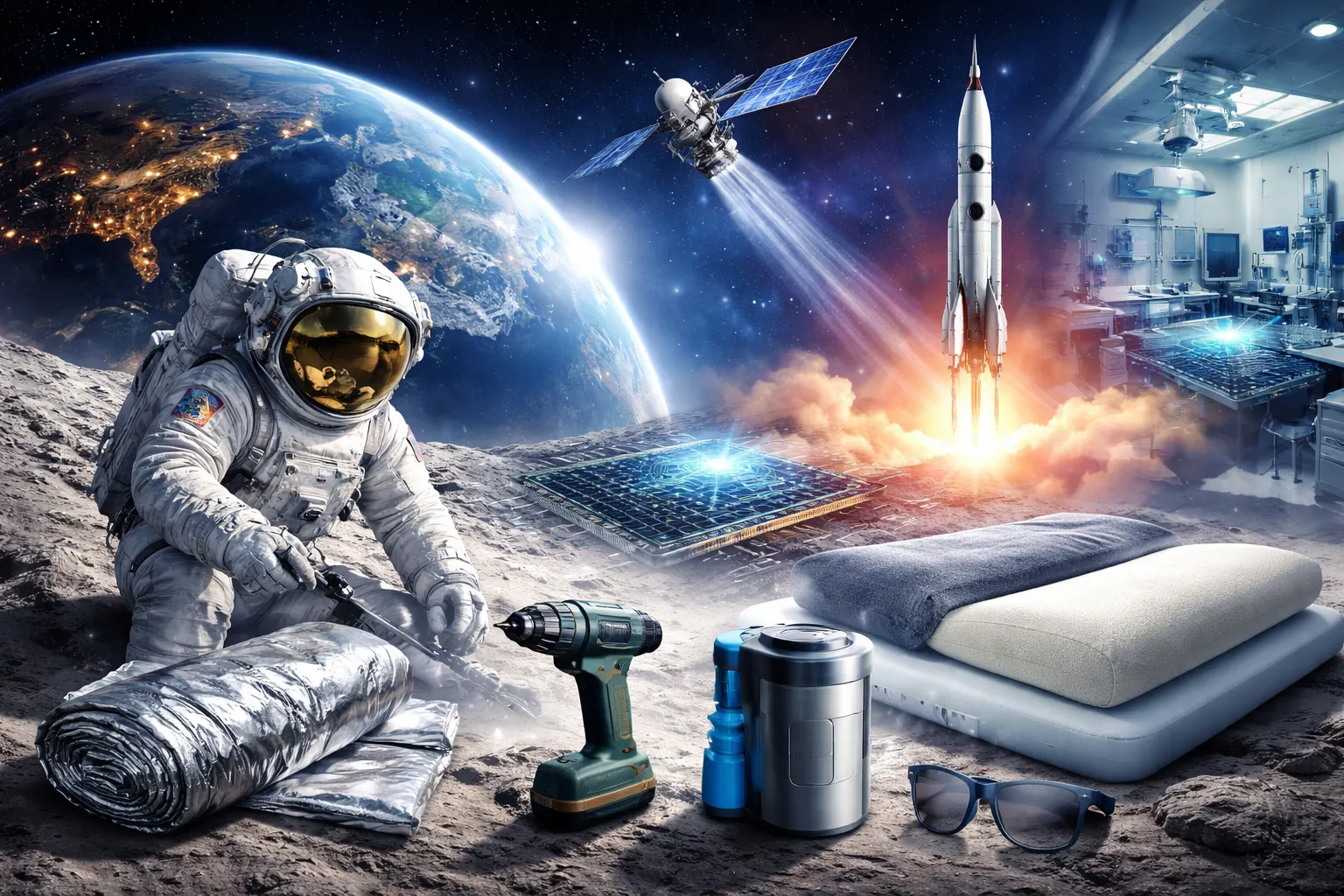
In the late 1960s, researchers pursued seat materials that could absorb energy, spread load, and recover shape. The viscoelastic “temper foam” they produced later gained a second life in medical pads, helmet liners, and mattresses. The civilian transition took years, because early formulations felt too firm for bedding. But once manufacturers tuned density and response, comfort and pressure relief went mainstream. This is a textbook Apollo program tech spinoff: a safety-driven material became a consumer staple—from hospital beds to pillows—without losing the properties that made it trustworthy in flight.
2) Cordless power tools: lunar cores to home repairs
Sampling on the Moon demanded a compact, battery-powered coring drill with careful energy management. Collaboration around that need sharpened algorithms for low-draw motors and battery packs. The know-how later informed handheld consumer tools and even cordless surgical instruments. The path was not a single leap; it was iteration—optimize, miniaturize, and ruggedize. NASA documents and case notes trace how a “moon tool” helped popularize an entire class of everyday devices. For one representative write-up, see the agency’s summary on cordless instruments.
3) Multi-layer insulation and the humble “space blanket”
Spacecraft radiate heat into a vacuum, so Apollo hardware wore ultra-thin reflective layers to manage temperature. The same principle powers the metallized emergency blanket found in first-aid kits and marathon finish lines. Light, cheap, and compact, it reflects body heat and resists wind. Firefighters and rescue teams use related thermal gear every day. The visible “foil” is the tip of a deeper iceberg: how to control heat flow with minimal mass. That principle shapes packaging, building materials, and outdoor equipment across price points.
4) Water purification lessons
Apollo’s closed systems forced engineers to think about microbial control, filtration, and by-product management in tight spaces. The lessons fostered compact purifiers and disinfecting approaches used far from labs—on boats, in clinics, and in disaster relief. Even when formulations differ, the design logic persists: monitor quality continuously, minimize consumables, and make maintenance obvious. When you refill a portable purifier today, you are using a trick born from life-support plumbing and checklists.
5) Scratch-resistant coatings and clear visors
Helmet visors needed clarity under UV and abrasive dust. Thin, hard coatings protected optics without adding weight. Eyewear manufacturers later adopted similar chemistries and deposition methods. The consumer win is durability: lenses that survive pockets, backpacks, and daily wiping. Again, the path matters. Apollo’s constraints—clarity, weight, and toughness—drove coatings that industry then refined for price and scale. Your glasses may not have flown, but their resilience owes something to Moon dust and visor tests.
6) Software reliability: from alarms to assurance
During Apollo 11’s descent, the guidance computer shed noncritical tasks and prioritized landing routines. That safe failure behavior came from deliberate software architecture and scheduling. The broader lesson—fail gracefully, log clearly, and prioritize the mission—migrated into medical devices, aviation, and industrial control. Today, audit trails, redundancy, and watchdog timers echo those choices. Many Apollo program tech spinoffs are actually policy and pattern: how we write, test, and certify code.
7) Freeze-drying done right
Freeze-drying is older than rocketry, but Apollo requirements forced supply chains to take consistency seriously: flavor, texture, and rehydration had to meet strict targets with zero surprises. Those controls later improved food safety and quality for hikers, hospitals, and breakfast bowls. When you taste a crisp freeze-dried berry in cereal, you are meeting a process refined by mission constraints. It’s a quiet win: better control, less waste, and predictable results at scale.
8) Image processing and diagnostics
Apollo’s mapping and navigation demanded digital image enhancement—noise reduction, contrast stretching, and edge detection. Those techniques later supported medical and industrial imaging. While Apollo did not “invent” a CT scanner, its software toolbox helped clinicians and engineers see more, sooner, and with less error. The real transfer is mathematical discipline under constraints: make faint signals legible without faking structure. That same toolbox helps satellites read clouds and doctors read scans.
9) Sensors, air, and public health
Spacecraft treated the cabin as a tiny planet: watch air quality, track trace gases, and manage particulates. Those habits, plus later satellite work, filtered into urban monitoring and building systems. The payoff became obvious after events like the Great London Smog reframed what cities owe citizens. In a modern office or clinic, invisible guardians click on and off, borrowing logic from checklists written for capsules.
10) Systems thinking for risk
Perhaps the most portable export is attitude. Apollo trained leaders to map whole systems—hardware, people, and procedures—as one network. That mindset now guides forensic work across fields. When geophysicists analyze a chain of events like the Krakatoa eruption, or when aviation reconstructs a stall cascade, they follow methods that spaceflight normalized. The same clarity shows up in industrial safety, transportation, and even financial risk analysis.
Conclusion
Moon rocks drew the headlines. The legacy that stayed home was subtler: methods, materials, and mindsets that make daily life safer and easier. Real Apollo program tech spinoffs succeed because they solve hard problems once, then solve softer problems a million times. They remind us that public ambition can seed private prosperity when knowledge flows freely. For a long view on why knowledge infrastructure matters, consider the stakes in the Library of Alexandria’s rise and loss. For a lesson in creative problem-solving under pressure, study the Ghost Army’s deception craft—different domain, same disciplined ingenuity.
If you want to explore documented cases with sources, NASA’s public archive curates decades of transfers and updates the list annually through its Spinoff program. The quiet revolution continues whenever constraints meet curiosity.