Coffeehouse politics Enlightenment Europe: how cafés built a public sphere
Coffeehouse politics Enlightenment Europe was never just chatter over a hot drink. In cafés, print culture, and postal routes, argument became routine. If you want a human face to this shift, meet the sharp-tongued philosophe in this profile of Voltaire. For the machinery behind the buzz—formats, editors, and censors—see this note debunking neat tales about the Renaissance “turning point” myths. What follows traces how a bitter, sober drink seeded habits that still shape public life.
Historical Context
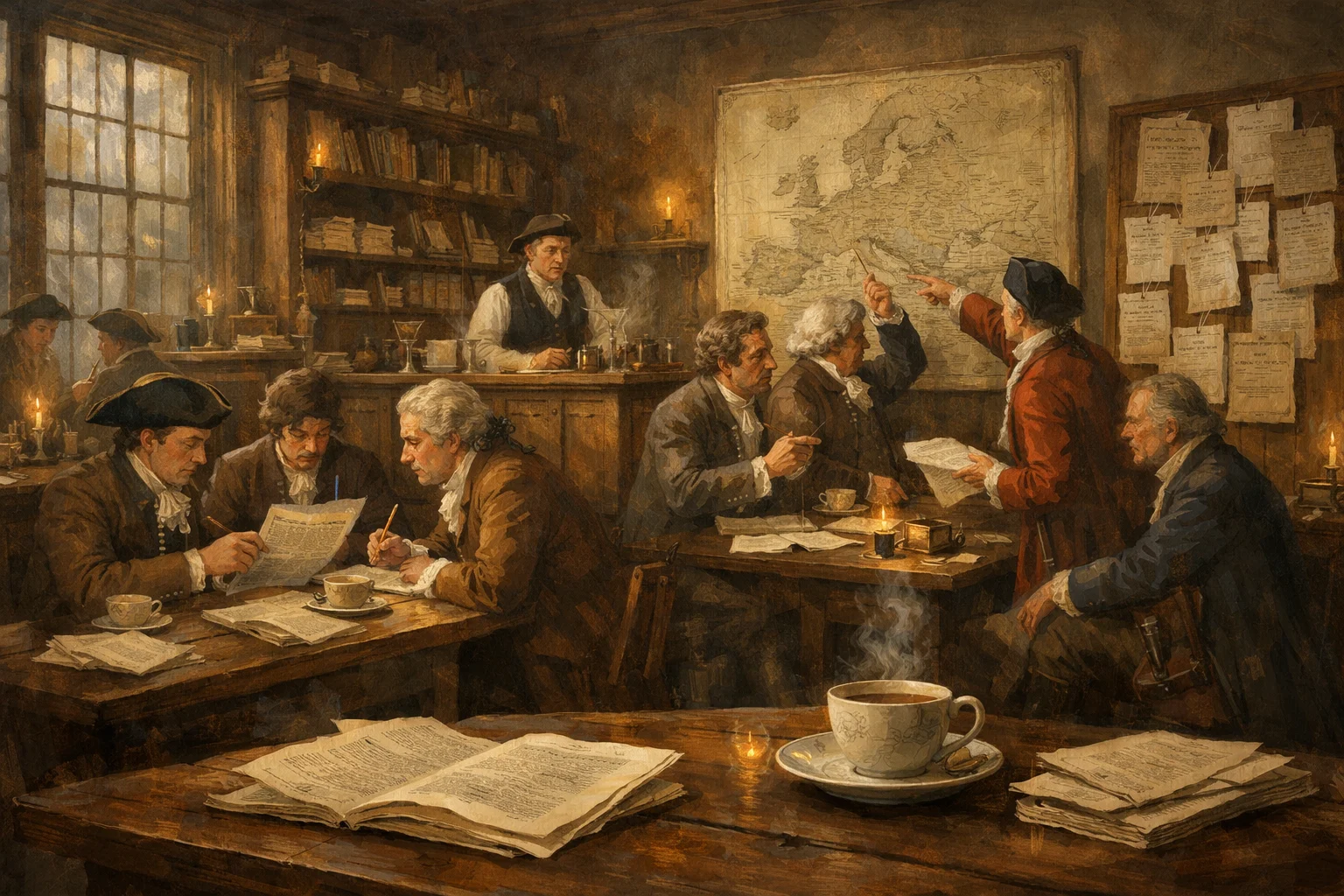
Seventeenth-century coffeehouses arrived from Ottoman models and spread through port cities and capitals. They offered space, cheap admission, and a steady supply of pamphlets and news. Patrons read aloud, argued, and wrote back. The setting normalized disagreement. That is why historians treat cafés as workshops for early citizenship, even as access was unequal and often male.
Print multiplied the effect. Newspapers, periodicals, and handbills kept distant rooms in the same conversation. Merchants compared prices; lawyers traded cases; natural philosophers debated method. Postal networks stitched it all together. Earlier upheavals mattered too. For the pipeline that moved texts and skills west, see this investigation into the Fall of Constantinople. It shows how translation, trade, and refugees primed Europe for later media booms.
Contemporaries called English cafés “penny universities” because a small coin bought entry to arguments and journals. Parisian rooms skewed more literary; Venetian cafés added spectacle to political gossip. Across regions, habits converged: read, test, reply. This is the civic rhythm behind Coffeehouse politics Enlightenment Europe. For a concise background on cafés as institutions, consult Britannica’s overview of the café.
Key Facts and Eyewitness Sources
Period diaries, police reports, and satire reveal what happened inside the rooms. Owners curated newspapers and subscription lists. Regulars formed circles that policed tone as much as content. When rumors spiked, the same rooms also spread panic. That is why officials alternated between tolerating and regulating cafés. Evidence from city records shows repeated raids, license checks, and occasional closures.
Pamphlets captured the feel of “rational-critical debate,” but also the bite of caricature. Addison and Steele’s essays modeled polite disagreement; lampoons made reputations. After the 1755 catastrophe, correspondence and verse rushed through cafés, turning a natural disaster into a moral argument—see how the Lisbon shock became a laboratory for reason and risk in this note on the Lisbon Earthquake 1755. The point is method: assemble facts, test claims, and publish counterclaims where people meet.
Across Europe, censorship shaped what survived. Licensing narrowed the printed record; coffeehouse memory kept the rest. Club minutes, court files, and commercial ledgers fill gaps. Together, these sources let historians weigh the promise and limits of Coffeehouse politics Enlightenment Europe. For a neutral primer on the era’s ideas, see Britannica’s entry on the Enlightenment.
Analysis / Implications
What made cafés special was not novelty but routine. They turned disagreement into a habit with rules: listen, reply, cite. The room rewarded concise arguments and penalized bluster. That style traveled into law, journalism, and markets. Insurance rates, policy plans, and experiment results all benefited from standardized debate. Coffeehouse politics Enlightenment Europe, in this sense, was an infrastructure of judgment.
But inclusivity was uneven. Women debated in salons and some cafés, yet many rooms were male clubs. Servants and artisans joined conversations in a few cities, not most. Habermas’s ideal of a single “public sphere” oversimplifies the map; real rooms formed overlapping publics with different gates and tones. Those overlaps still mattered. They taught people to separate persons from positions, and to prefer verifiable claims over pedigree.
When pressure spiked, these habits scaled. In France, café talk connected pamphlets, petitions, and crowds—see the long fuse unpacked in French Revolution causes. In North America, debate migrated from coffeehouses and taverns to town halls and committees—trace that arc in this American Revolution timeline. The shared lesson: argument becomes power when institutions welcome it.
Case Studies and Key Examples
London’s networks. By the early eighteenth century, the city hosted hundreds of coffeehouses with distinct profiles. Lloyd’s gathered maritime intelligence; the Grecian drew natural philosophers; others favored stock news or satire. The form mattered: open tables, shared papers, and cheap entry disciplined claims. Reputations rose or fell on yesterday’s correction. The room’s memory became a quiet court.
Paris and the politics of presence. In the 1770s and 1780s, cafés near theaters and clubs amplified pamphlet wars. Performances bled into street argument, then into committees. Café Procope symbolized a literary style that could harden into policy. Public writing turned private grievances into common causes. Coffeehouse politics Enlightenment Europe thus trained citizens to think in articles, not whispers.
Venice and Vienna. Caffè Florian offered cosmopolitan ritual; Viennese rooms, later famous, show how practice outlived the Enlightenment. Newspapers, chess, and letters kept the debate going even as empires shifted. The core habit persisted: dispute in public, then publish. In quieter times, that habit fed science and trade. In crises, it organized action.
Disaster as a stress test. After Lisbon’s quake, cafés filled with eyewitnesses, clerics, and engineers. Arguments about providence met arguments about probability. The pattern matters today: rooms that reward evidence help communities pivot from myth to method. That is the deepest promise of Coffeehouse politics Enlightenment Europe—an ethic of proof that survives the shock.
Analysis / Implications
Cafés linked knowledge to accountability. Merchants priced risk more rationally. Printers learned demand from overheard debates. Magistrates tracked sentiment without spies. The spillovers were practical: better credit, clearer laws, and more precise reporting. When this fabric thinned, rumor won. When it thickened, data did. Coffeehouse politics Enlightenment Europe grew into a civic muscle memory.
Still, two caveats sharpen the picture. First, coffeehouses did not replace older institutions; they complemented courts, churches, and guilds. Second, they were never neutral. Owners curated sources; regulars enforced norms. The safeguard was pluralism: many rooms, many angles. That redundancy made societies less brittle. It also explains why reformers fought to keep cafés open when rulers tried to close them.
Historical Context (Revisited)
Tracing the lineage back clarifies continuity. Medieval and early modern translation chains, revived after 1453, widened the pipeline of texts and skills. Printers standardized formats; readers learned to skim and compare. The café sat at the end of this chain, where a pamphlet met a person with time to argue. Coffeehouse politics Enlightenment Europe distilled all those flows into a daily practice thousands could join.
In that sense, the drink mattered less than the discipline. Bitter, stimulating, and social, coffee fit a culture that prized alertness and exchange. The rooms offered light, tables, and time. Add a post office nearby and a printer down the street, and you have a small republic of letters. Individuals felt larger than themselves; institutions learned faster than before.
Conclusion
Europe’s cafés did not invent reason, but they gave it a home address. They made debate ordinary, portable, and accountable. When we say Coffeehouse politics Enlightenment Europe, we name a civic habit: collect facts, argue in public, and accept correction. That habit still guards modern life against panic and propaganda. If you want a cautionary mirror about fear and due process, revisit the Salem witch trials. For a modern lesson in risk communication grounded in measurement, see why Hiroshima and Chernobyl diverge in this evidence-first comparison. The room has changed—today it is also digital—but the rule holds: better arguments build better worlds.